ECG Guru - Instructor Resources

A gathering place for instructors of ECG and cardiac topics.


Subscribe to me on YouTube

WCT

Ventricular Tachycardia

Sat, 11/24/2012 - 15:52 -- Dawn

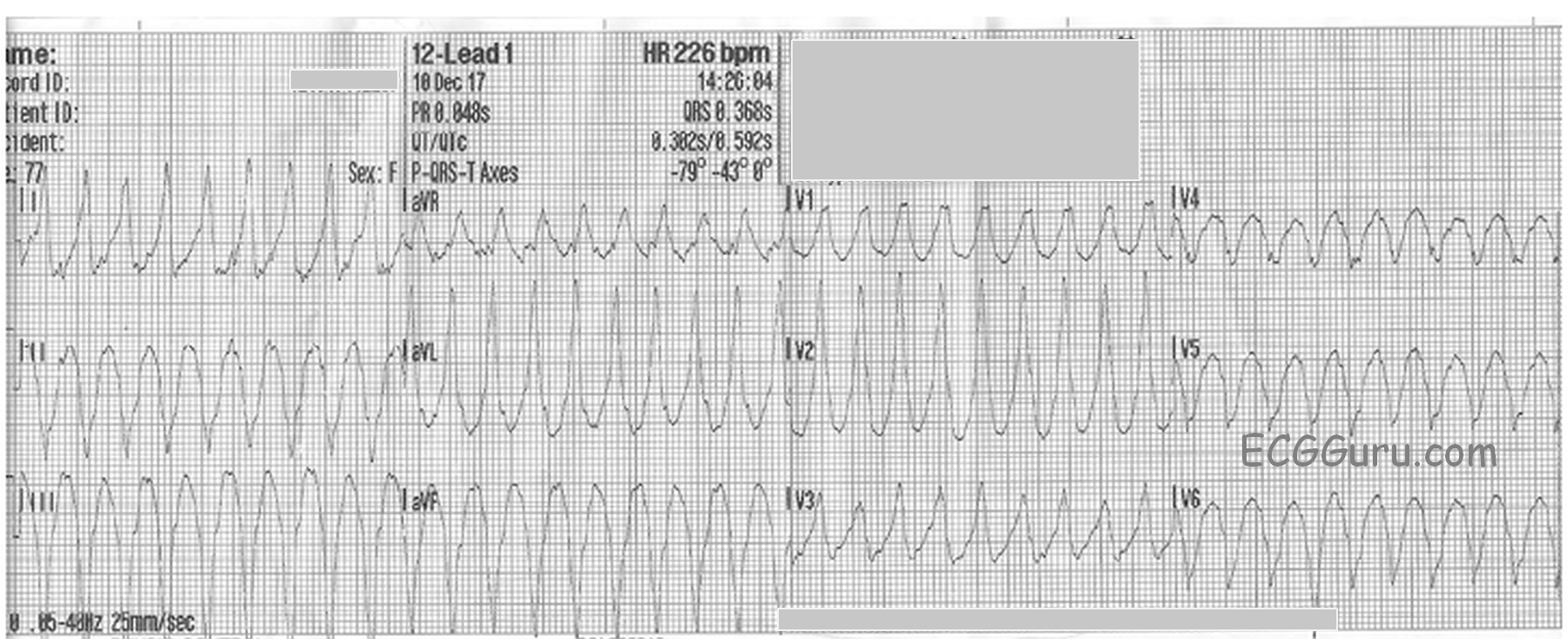
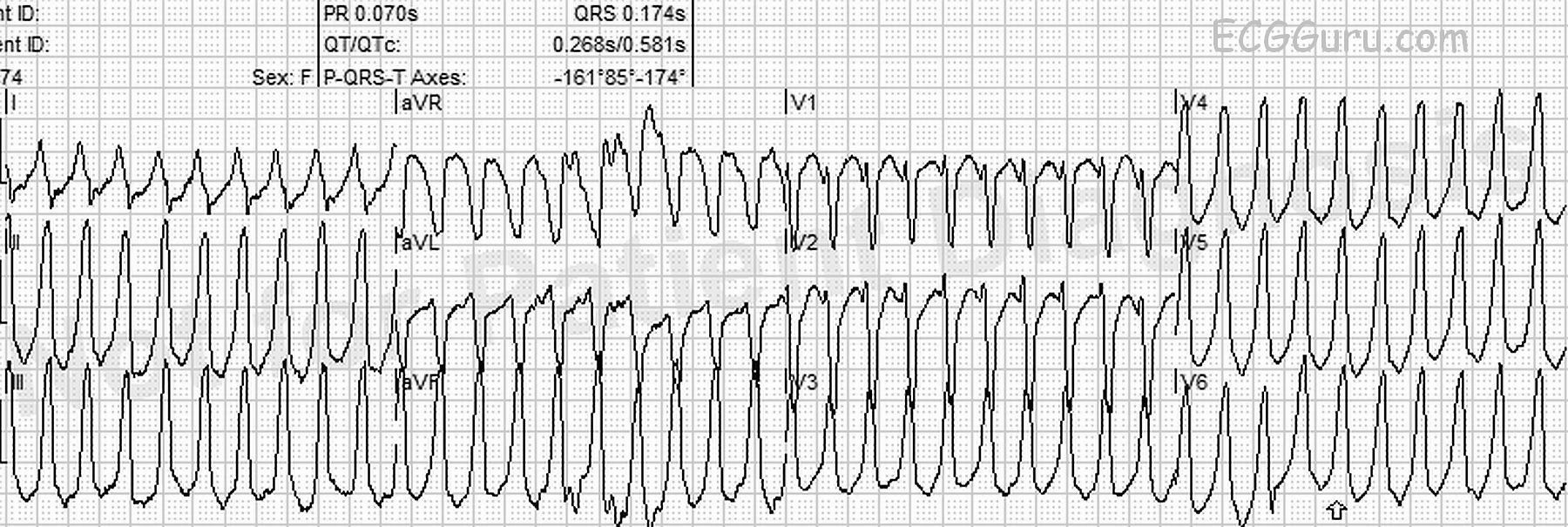
This is a good example of ventricular tachycardia with PRECORDIAL CONCORDANCE.  The QRS complexes in the chest, or precordial, leads all point downward.  When the precordial leads are all  negative or all positive in a wide-complex tachycardia, there is virtually a 100% chance that the WCT is ventricular tachycardia.  This ECG shows many characteristics of VT, including the extreme "backwards" axis:  aVR is positive and II, III, and aVF are negative.  Lead I is almost equiphasic.  Also, the lack of a clear BBB pattern and a negative V6 are strongly suggestive of VT.  REMEMBER:  In the treatment of wide-complex tachycardia, the rhythm should be considered VT unless proven otherwise.  This is especially true in unstable patients, patients over 50 years old, and patients with known heart disease.

INSTRUCTORS' NOTE:  We purposely left the machine interpretation on this week's ECG of the Week.  How many errors did the machine make?  This might be a good teaching point for students of all levels.


Ventricular Tachycardia

Wed, 09/12/2012 - 00:00 -- Dawn

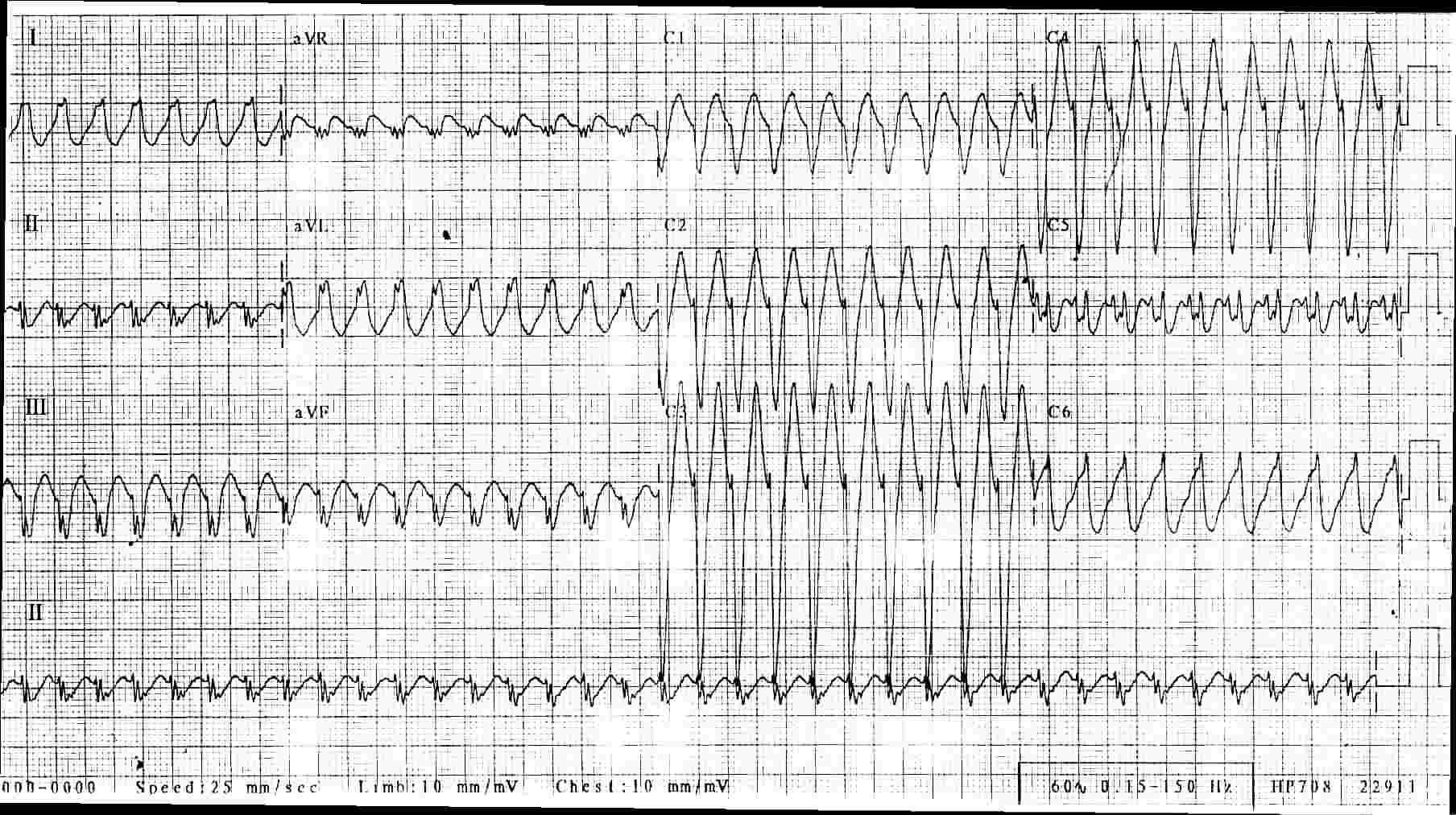
A 66 year old man is complaining of palpitations and chest pain which radiated to his left arm and neck, which lasted 20 minutes, then went away.  Paramedics found him in V Tach.  His BP was 120/80 and his pulse 120/min. He converted to a narrow-complex rhythm while being given amiodarone, but became nauseated.  He returned to V Tach, and his symptoms disappeared.  This patient had an implanted defibrillator, which never went off.  How do we know this is V Tach?

First, ALWAYS consider any wide-complex tachycardia to be VT unless you have proof that it is not.  When symptoms include chest pain, it can be especially dangerous to miss the diagnosis of VT.  Remember, some VT can be asymtomatic, even for prolonged periods of time.

ECG signs that this is VT include: QRS is extremely wide (>.14 sec), no P waves associated with the QRS complexes, negative complexes in V4, V5 and V6.  In fact, this patient has negative "precordial concordance" - all the chest leads are negative. This is a strong sign of VT.  The wide little r wave in V1, greater than .04 sec (one small block) is a strong indicator of VT, as is the delayed nadir of the S waves in V1 through V3 (the slope of the S wave is not steep, indicating a long time to depolarize the ventricles).

For more about V Tach criteria, browse this site and visit the ECG blogs on the Favorites page.  It is a favorite topic among ECG experts.


Wide-Complex Tachycardia Converted by Adenosine

Mon, 08/13/2012 - 15:58 -- Dawn

This ECG was presented earlier this week as an example of SVT with LBBB aberrancy, which was ultimately converted with one dose of adenosine in the Emergency Department.  It is the most shared and commented on ECG yet to appear on the Guru.  The diagnosis given was the one accepted by the medical staff who cared for the patient, who was a man in his 30's who presented to the Emergency Department complaining of a rapid heart rate.  He was ambulatory with stable vital signs, in spite of the tachycardia. He reported that he has had several episodes of fast heart rate which responded to either Valsalva maneuvers or, in some cases, medication in the ED.  He was told he might benefit from an ablation procedure, but he did not have health insurance and continued to use the ED as his primary source of medical care.  When he was admitted to the ED, the tech initially called for help, thinking the monitor showed ventricular tachycardia.  The ED physician felt that this represented LBBB aberrancy, possibly rate-dependent, and he treated the patient with adenosine.  The rhythm converted to sinus after one dose, and the patient remained stable throughout the process.  He was advised to undergo further observation and testing, but he declined due to financial concerns, and the fact that he usually succeeded in relieving his symptoms with "bearing down".  

Wide-complex tachycardias can be difficult to assess simply from an ECG. The patient's stability depends more upon general health and cardiac output issues than the origin of the tachycardia.  When we presented this ECG, we also presented the diagnosis he had upon discharge from the ED.

Subsequently, ECG Guru Dr. Ken Grauer, a frequent contributer to this site, offered his alternative diagnosis and his explanation of why he believes this to be v tach.  Other well-respected ECG experts have also questioned the original diagnosis.  Please refer to the comments below for this very helpful explanation.  Unfortunately, this patient is lost to followup, as this incident occurred some time ago.

WTCs remain a most fascinating topic, especially for those who enjoy "detective work".  We thank Dr. Grauer, Tom Bouthillet, and others for their contributions to the ECG Guru on this topic.
   

Wide Complex Tachycardia: V Tach

Sat, 06/02/2012 - 16:02 -- Dawn

This wide complex tachycardia occurred in a 91 year old man with a history of atrial fibrillation. He complained of "fluttering" in his chest, and denied chest pain or other problems.  While the paramedic attempted to start an I.V., he spontaneously converted to atrial fibrillation with left BBB, and PVCs.  Once he converted, his symptoms abated.  Remember, all wide complex tachycardias (WCT) should be treated as V Tach in the field, as this is by far the most common WTC and the most dangerous.

Some of the ECG clues that this WTC is ventricular tachycardia are:

* Monophasic upright QRS in V1  (does not have RBBB pattern of rsR')

* Extreme left axis deviation (II, III, and aVF are negative, I, aVL, and aVR are poisitive)

* V6 is negative


For a more thorough discussion of the ECG signs of V Tach, go to Jason Roediger's Ask the Expert page discussion on the topic:

http://www.ekgguru.com/node/157

Wide Complex Tachycardia in a Patient with WPW

Mon, 03/12/2012 - 18:03 -- Dawn

This ECG was submitted by Sebastian Garay, EMT-P and ECG Guru (and ECG Guru Member sebmedic). It is a very interesting case of wide complex tachycardia in a patient with Wolff-Parkinson-White.

This is from a 57 year old man who sought medical help for a complaint of palpitations. He was known to have WPW. The paramedics determined that he was hemodynamically unstable, and in light of the wide-complex tachycardia, they performed a synchronized cardioversion at 100 j. The patient converted to the rhythm shown in the next ECG. The paramedics then administered a Lidocaine bolus and drip, considering this to be a ventricular tachycardia. The patient arrived in the Emergency Dept in improved hemodynamic condition.

This ECG can be used to teach V Tach for beginner students, WPW and WCT tachycardia differential diagnosis for more advanced students. It is also a good ECG for axis discussion, and for how lead placement affects the final product.

The differential diagnosis here is 1) V Tach and 2) SVT with aberrant conduction or left ventricular conduction delay. For a discussion of ECG criteria which help us diagnose WCT, see the "Ask The Expert" column from Jan. 11, 2012. Characteristics that make this look like V Tach include: wide complex and significant left axis deviation. Features which may favor a diagnosis of SVT are the pre-existing WPW and a rate of 222/min. There are no p waves seen. NOTE: V2 in this ECG appears to reflect electrode mis-placement, as it does not "make sense" in the normal progression of the QRS complexes in the precordial leads. It is clearly "out of place".


The second ECG shows the same patient after conversion of the tachycardia.  The delta waves of WPW are easily seen.

Wide Complex Tachycardia: Left Bundle Branch Block With Subsequent Rhythm Strip

Wed, 11/30/2011 - 13:55 -- Dawn

 This wide complex tachycardia has an initial rate of 129/min. It is difficult to discern if P waves are present, although the ECG machine does give us a PR interval. The ECG meets most of the criteria for left bundle branch block: wide QRS, negative QRS in V1, positive QRS in Lead I and V6. However, it is difficult to say for certain that this is a supraventricular rhythm. Later, however, the patient's rate slowed (see top strip), revealing P waves. When the rate slowed, the left bundle branch block pattern remained. That helps confirm the original interpretation of left bundle branch block. Interestingly, the BBB is not rate-related, in that it is still present at the slower rate.
You may use this image free of charge to enhance your presentations or student handouts. Click on image, or, for best image quality, right click and SAVE image. For permission and charges for use in publications or for marketing uses, please contact the owner at ECGGuru@Comcast.net.
This work is licensed under a Creative Commons Attribution-NonCommercial 3.0 Unported License.
 

Subscribe to RSS - WCT