ECG Guru - Instructor Resources

A gathering place for instructors of ECG and cardiac topics.


Subscribe to me on YouTube

Atrial Fibrillation

jer5150's picture

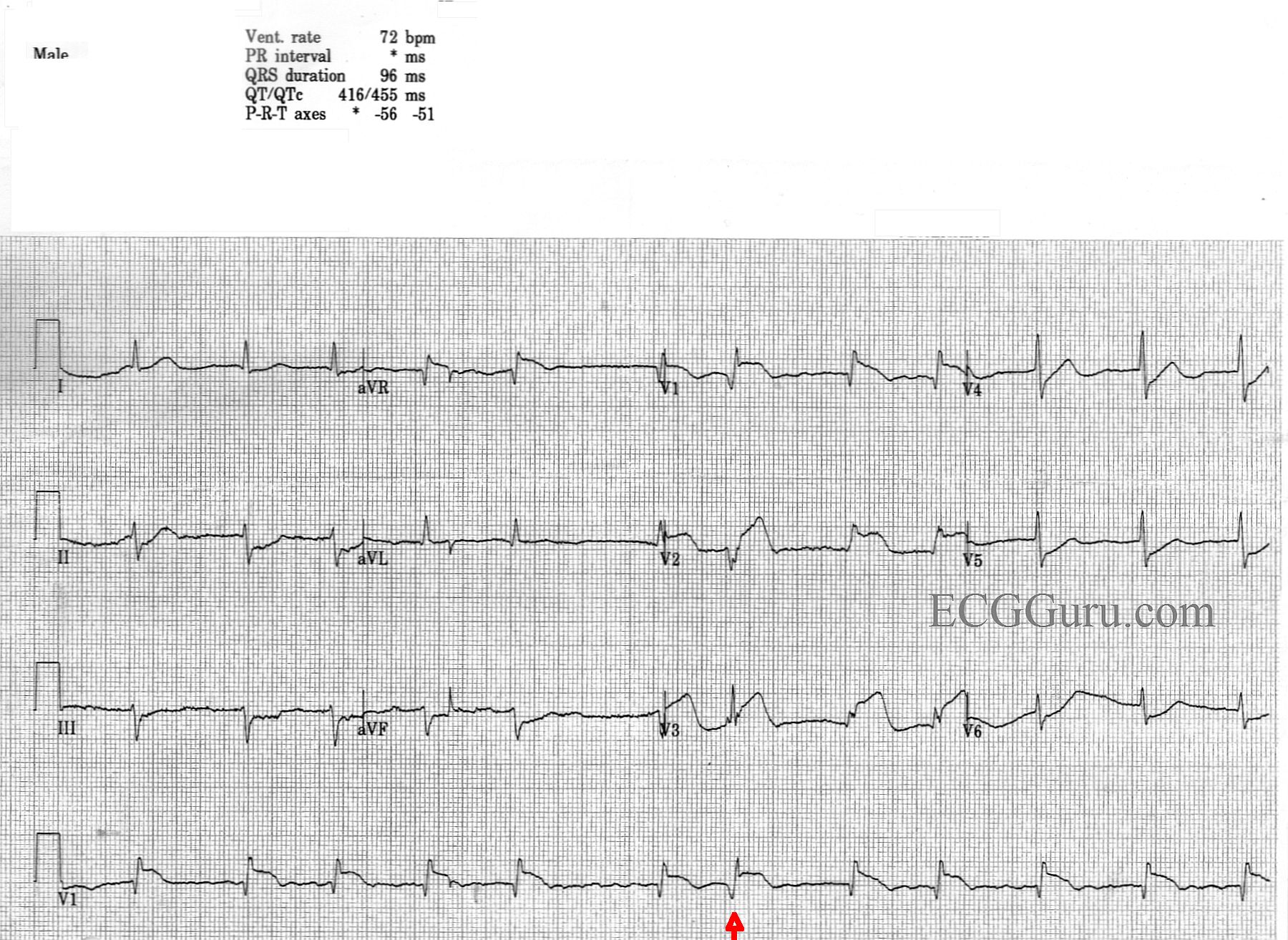
Jason's Blog: ECG Challenge of the Week for Dec. 16th - 23rd.

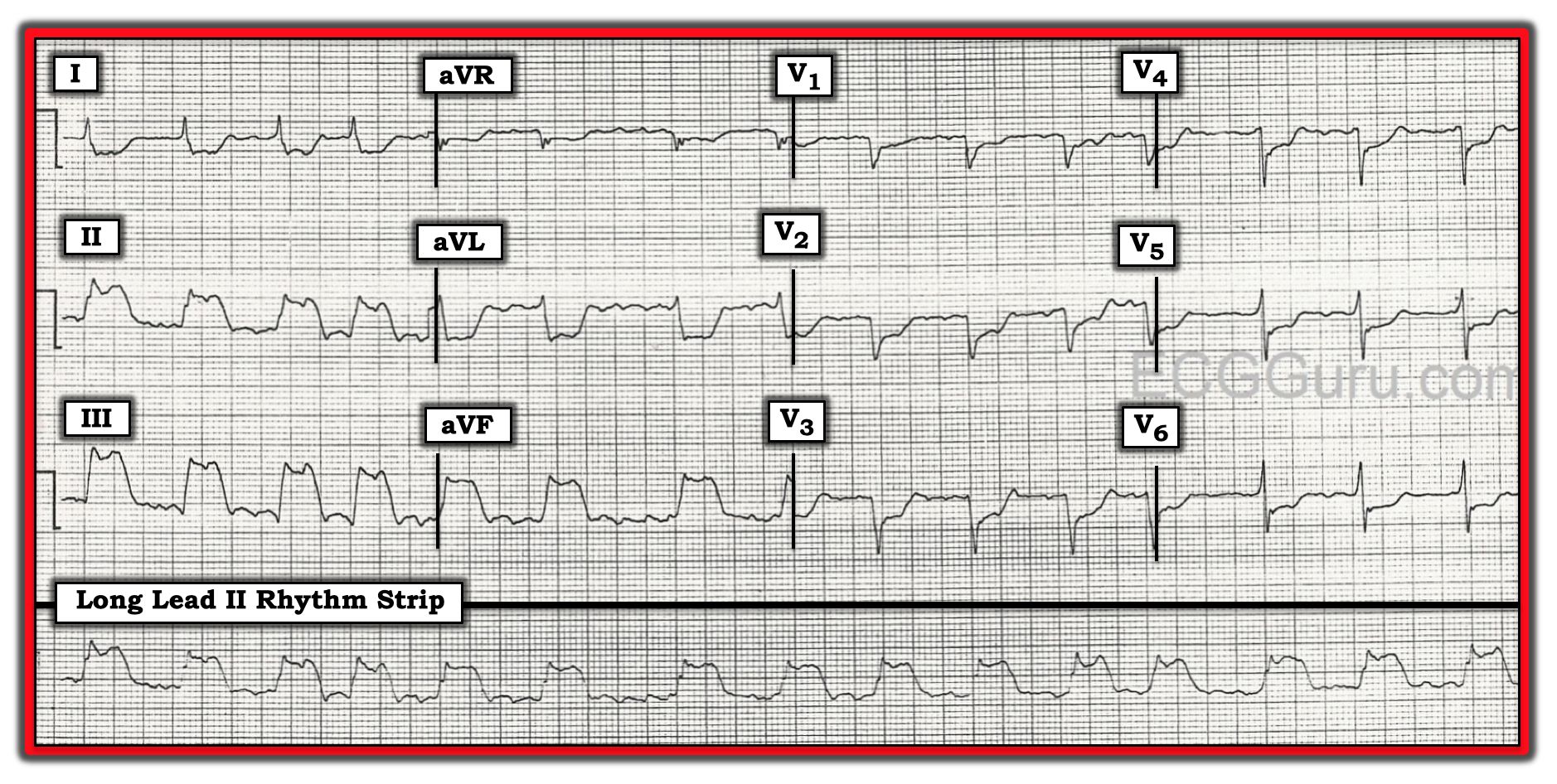
Found this "gem" buried deep-down in the back of the vault and have wanted to share it for many months.  Due to the impressive QRS voltage and overlapping waveforms, I initially debated on whether or not I should post this at 1/2-standard but in the end I decided to retain its original size.  This ECG is from 27 years ago so I have very limited information, but this is what I do know.

Anterior Wall M.I. With Atrial Fibrillation

Tue, 09/04/2012 - 15:59 -- Dawn

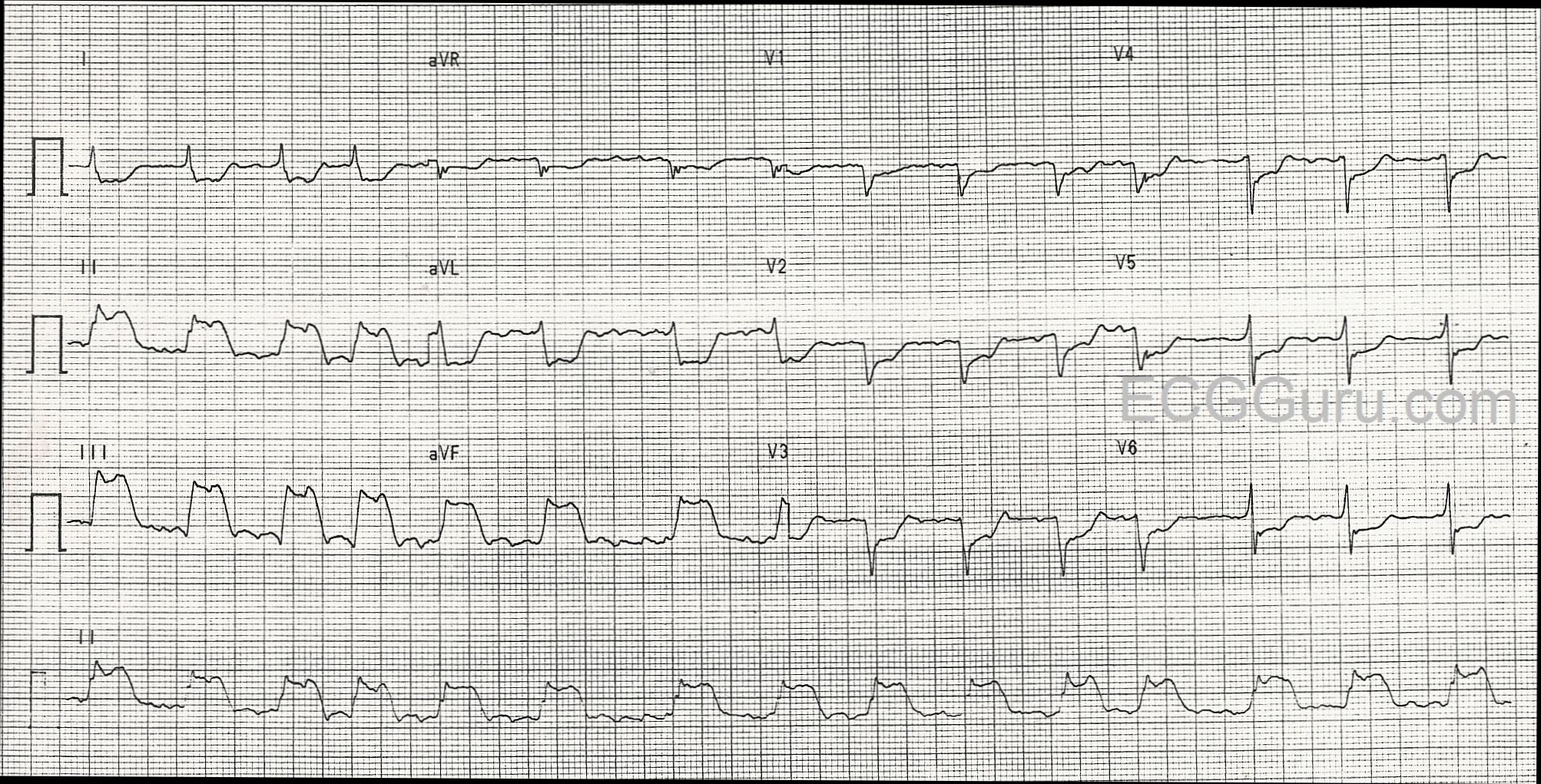
A good teaching ECG, showing clearly elevated ST segments in V1 through V4.  This patient had an LAD occlusion.  In addition, he has new-onset atrial fib at a rate of about 120/min.  Atrial fib has decreased cardiac output because of the loss of P waves prior to the QRS complexes, and a resultant decreased ventricular filling pressure.  In addition, this fast rate contributes to increased myocardial oxygen demand and damage.  An early priority, along with getting this patient to PCI, is slowing the rate.

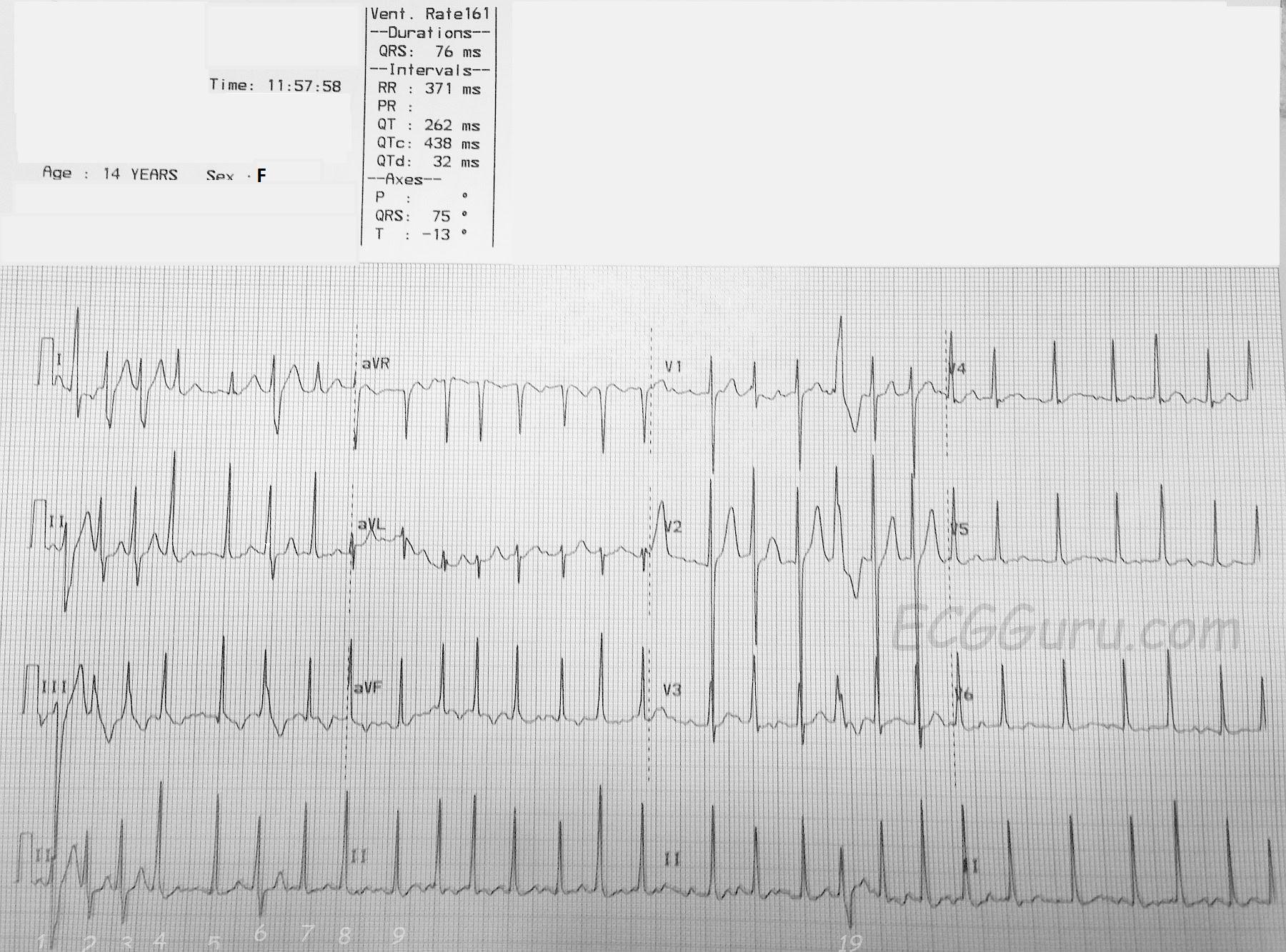
Atrial Fibrillation With A Rapid Ventricular Response

Wed, 05/16/2012 - 17:52 -- Dawn

This is a good example of atrial fibrillation with a rapid ventricular response. The rate is around 150 per minute, and the rhythm is almost regular.  Show your students how to "march out" the QRS complexes so they can see the irregularity.  When the rate is around 150, also check for atrial flutter with 2:1 conduction.  In this case, none of the 12 leads shows strong evidence of flutter waves, but it is a possibility when the rhythm is almost regular.  Fortunately, the initial treatment for both AFib and AFlutter with rapid response are the same.

Atrial Fib, Bifascicular Block, Pacemaker

Tue, 04/10/2012 - 14:53 -- Dawn

Lots of information in this ECG! The underlying rhythm is atrial fibrillation with a controlled rate. The QRS is .12 seconds in duration, with an rSR' pattern in V1 and a wide s wave in Leads I and V6, indicating right bundle branch block. In addition, the axis is leftward - Leads I and aVL are upright and Leads II, III, and aVF are negative. There is no other obvious reason for the left axis shift, and therefore, the diagnosis by exclusion is left anterior fascicular block. RBBB and LAFB often appear together, as the right bundle branch and the anterior fascicle of the left bundle share the same blood supply from the left coronary artery. ALSO, this patient has a right ventricular pacemaker, and is pacing appropriately when the atrial fib slows. Pacer spikes are not readily seen, but the width of the QRS, the axis of the wide QRS complexes (left), and the timing (after a pause) all support the paced rhythm diagnosis. V5 and V6 actually show a very tiny hint of a spike. The T wave inversions seen in the upright leads are common with RBBB, and are usually considered normal in this setting.

Wide Complex Tachycardia, 12 Lead ECG and Rhythm Strip

Wed, 11/30/2011 - 14:22 -- Dawn

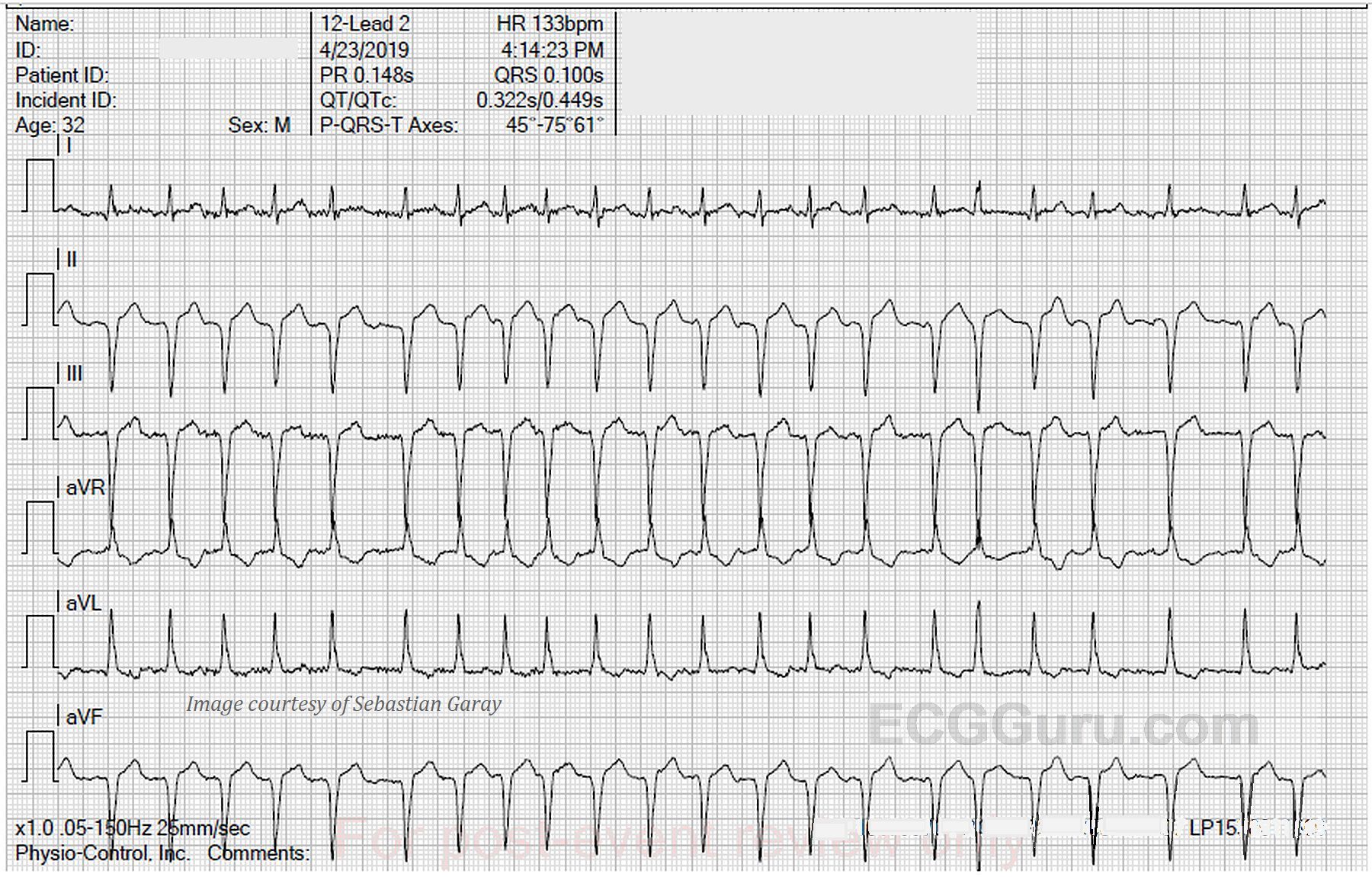
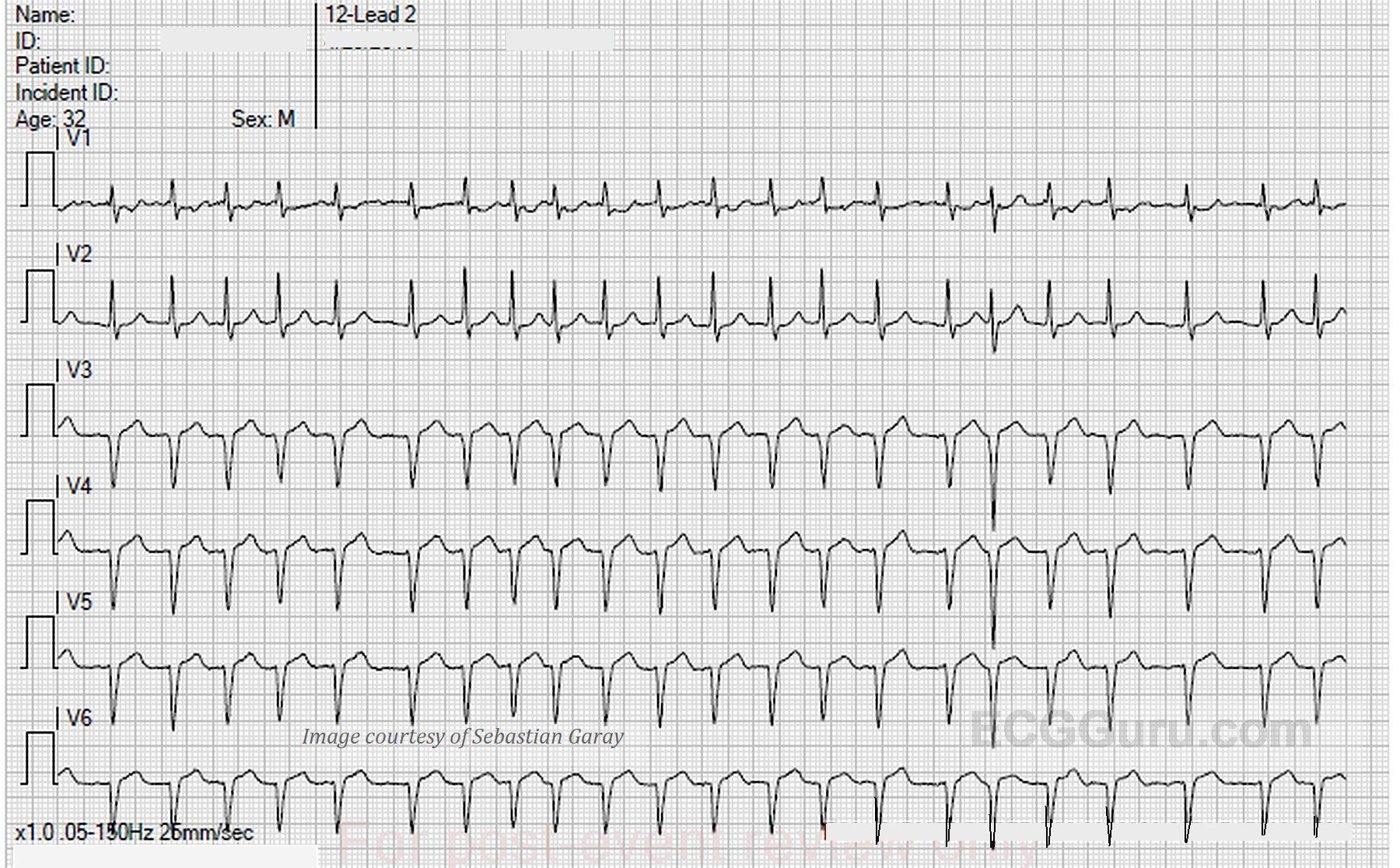
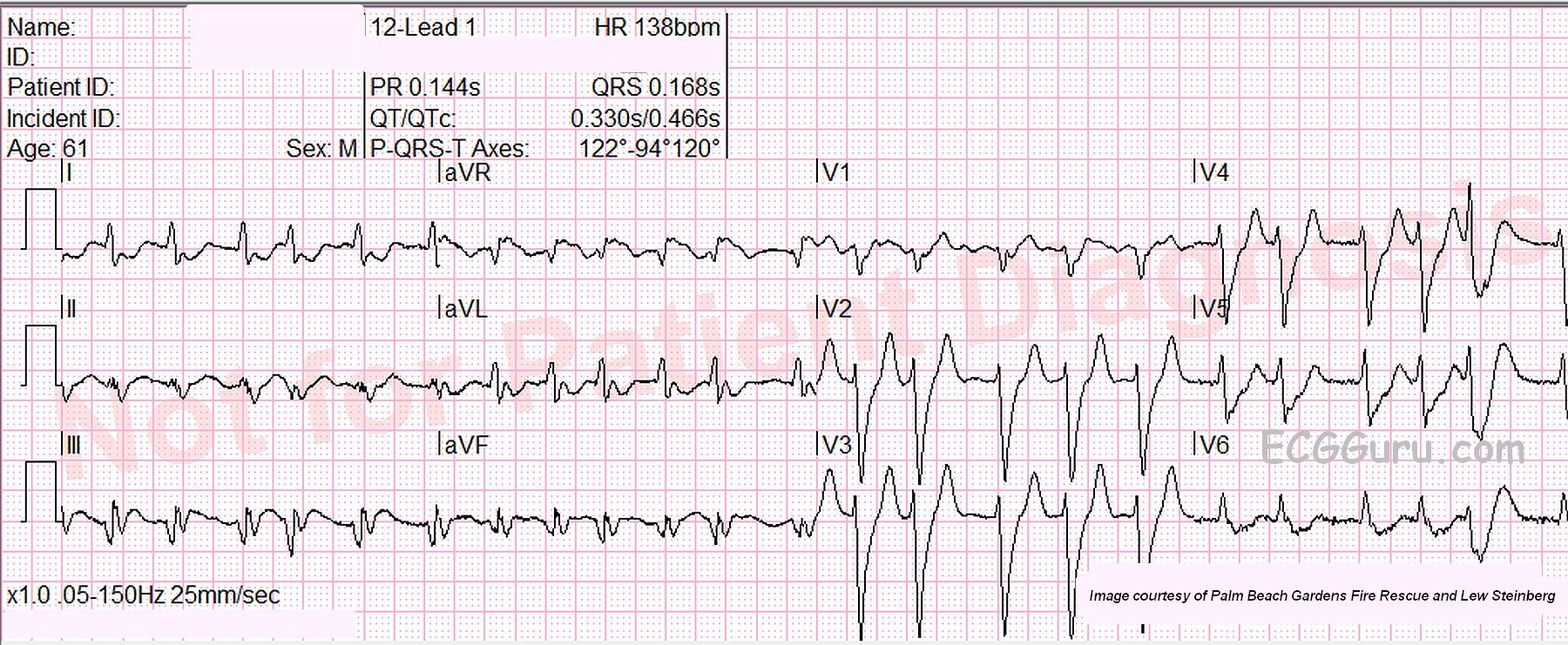
This is a good example of wide complex tachycardia that must be evaluated for V Tach vs supraventricular rhythm with left BBB.
The rhythm initially looks regular, but becomes irregular in V1 - V3. No P waves are seen prior to the QRSs, even when the rate slows down. The typical pattern for left bundle branch block exists: wide QRS, negative QRS in V1 and positive QRS in Lead I and V6. The irregularity suggests atrial fibrillation. A longer rhythm strip would be very helpful here. The axis, which is extreme left, could be from V Tach OR left BBB. There is no precordial concordance, favoring LBBB.
You may use this image free of charge to enhance your presentations or student handouts. Click on image, or, for best image quality, right click and SAVE image. For permission and charges for use in publications or for marketing uses, please contact the owner at ECGGuru@Comcast.net.

Inferior Wall M.I. and Atrial Fibrillation

Mon, 11/28/2011 - 19:22 -- Dawn

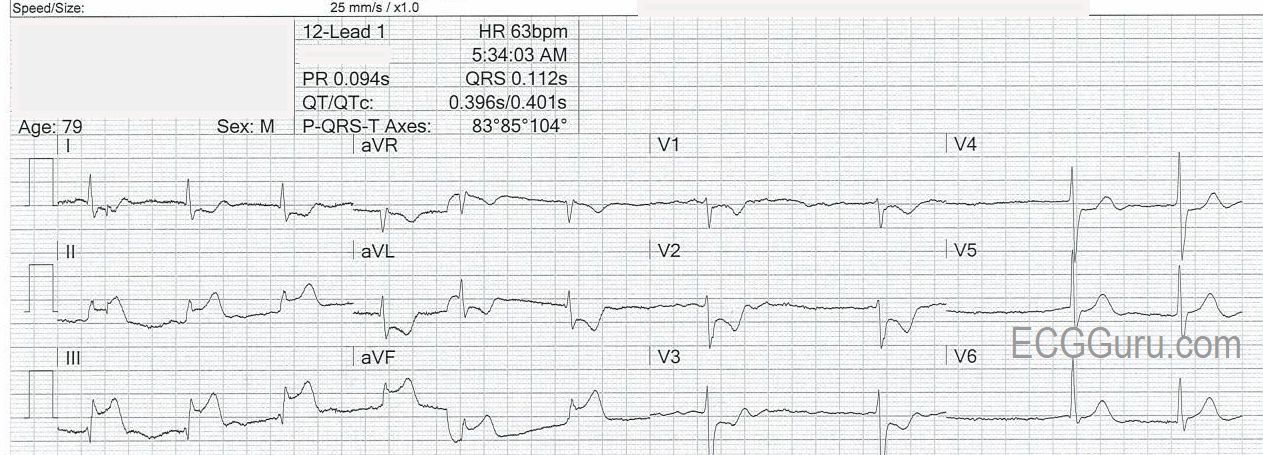
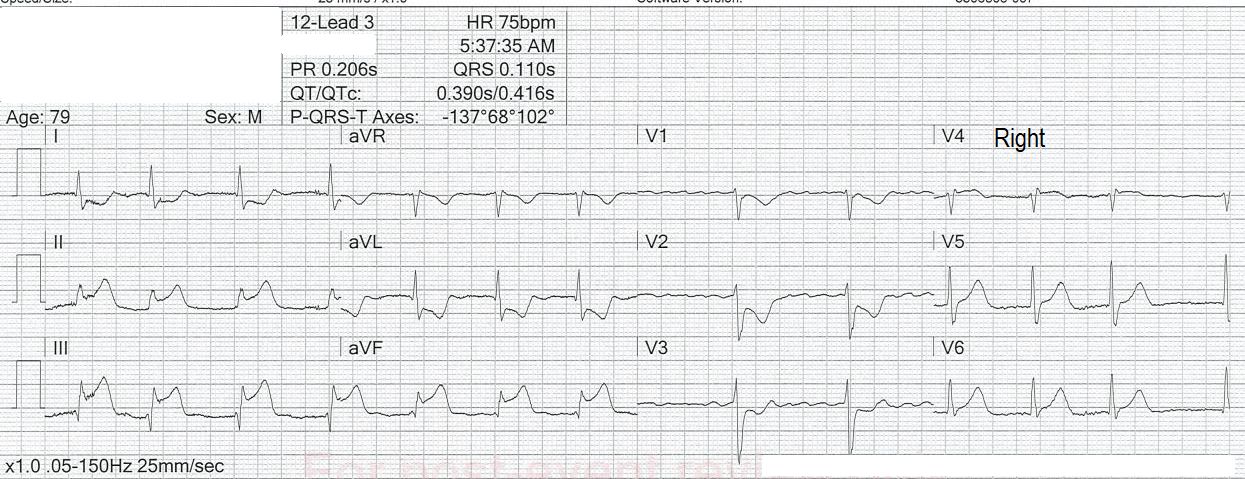
This 31 year old man presented to the Emergency Dept. complaining of chest pain, shortness of breath, and nausea. His heart rate on admission was 120 - 130 bpm and irregular, and the monitor showed atrial fibrillation. His rate slowed with the administration of diltiazem. His 12-lead ECG shows the classic ST elevation of inferior wall M.I. in Leads II, III, and aVF. This patient also had JVD, bibasilar rales, orthopnea, and exertional dyspnea, signs of CHF. He had no history of acute M.I., CHF, or atrial fibrillation. He offered no history of drug use or medications.

This ECG is very useful for the basic student, in that the ST elevations are readily seen, and the atrial fib is definitely irregularly-irregular. For the more advanced student, the ST depression in V2 indicates posterior wall injury, while the flat ST segment in V1 indicates that, while the posterior wall is trying to depress the ST segment, the right ventricle is trying to elevate it, resulting in flattening. This should be confirmed with a V4 right, or all chest leads done on the right side.

Also, this ECG can start a very instructive discussion on the relationship between acute M.I., acute CHF, and new-onset Atrial Fibrillation. That could be an entire class by itself!
This patient was transferred to a nearby interventional cath lab, and his outcome is unknown.<br />

Subscribe to RSS - Atrial Fibrillation