ECG Guru - Instructor Resources

A gathering place for instructors of ECG and cardiac topics.


Subscribe to me on YouTube

RBBB

Instructors' Collection, ECG of the WEEK, May 13, 2013: Right Bundle Branch Block With Left Posterior Fascicular Block

Mon, 05/13/2013 - 10:09 -- Dawn

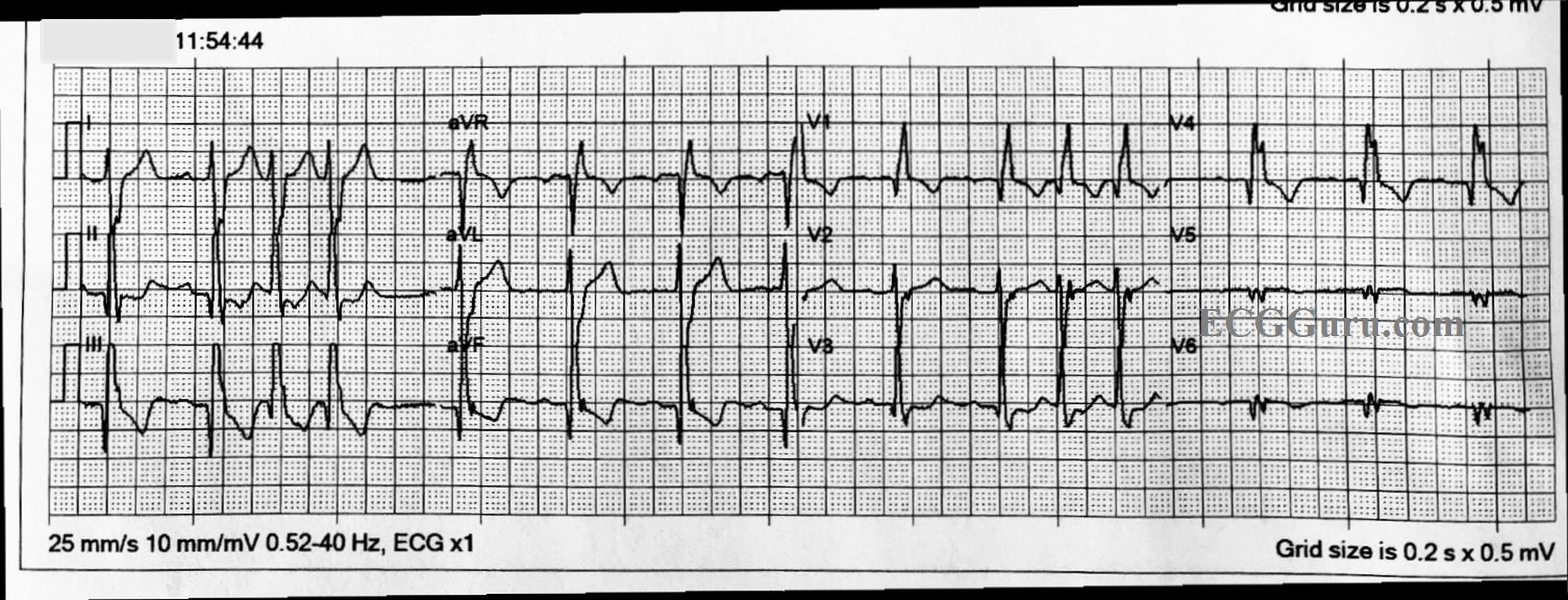
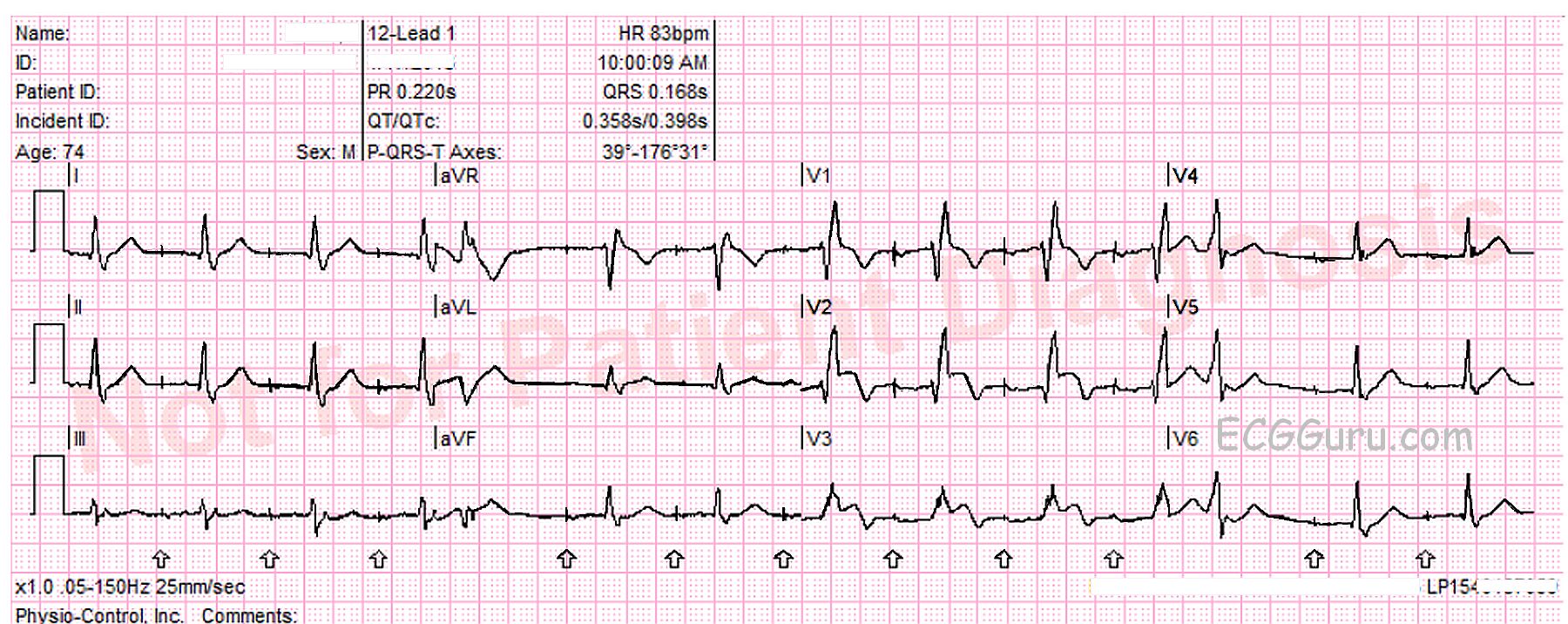
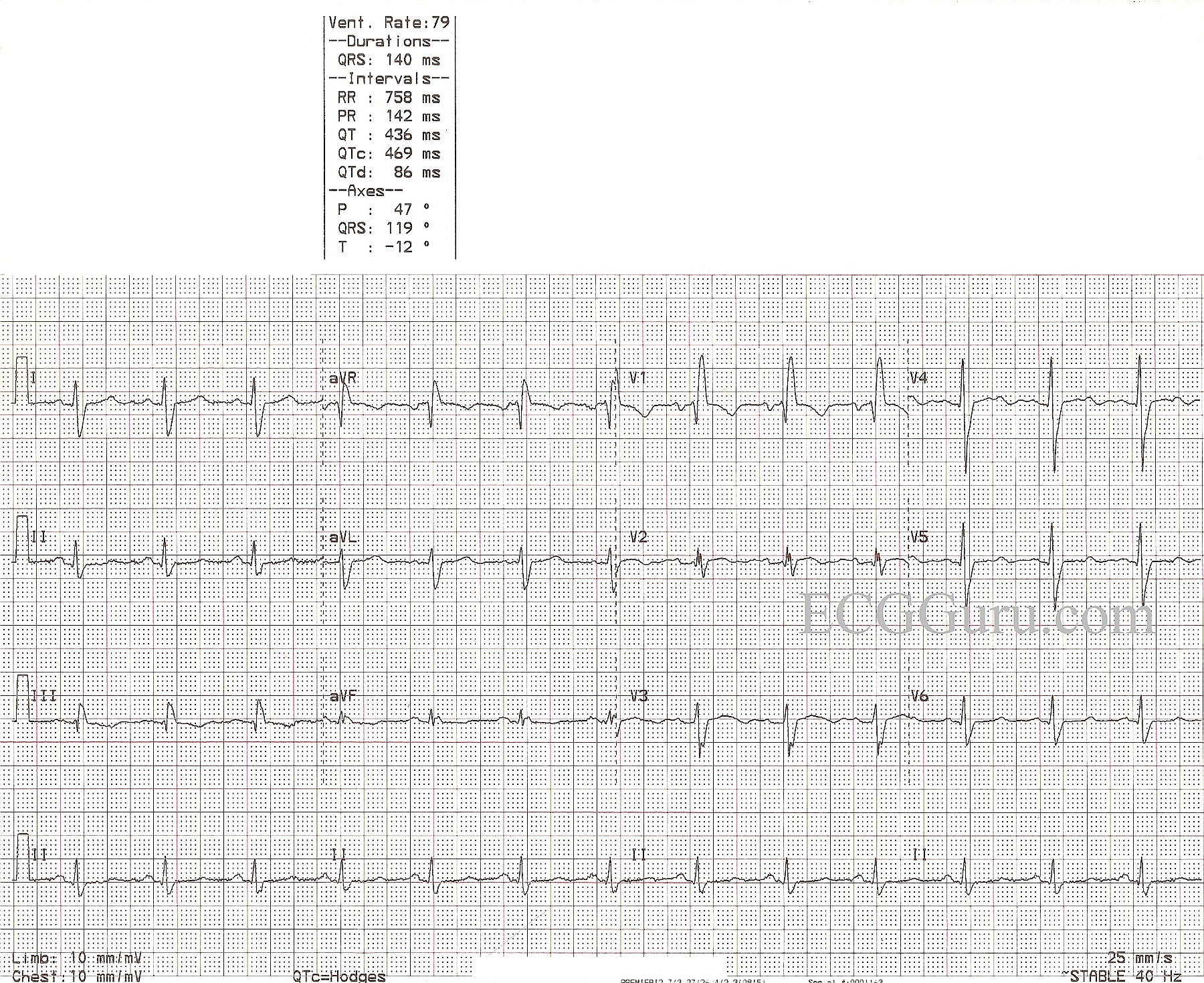
This is a good clear example of right bundle branch block with left posterior fascicular block.  The RBBB is diagnosed by the following criteria:  wide QRS (.12 sec), supraventricular rhythm (NSR), an rsR' pattern in V1, and wide little s waves in I and V6.  The LPFB is inferred by the right axis deviation (Lead III QRS is a bit taller than Lead II and Leads I and aVL are negative), and the fact that there is no other obvious cause for right axis shift noted in this patient.  This constitutes a BIFASCICULAR BLOCK.  The ventricles are being depolarized by way of the anterior fascicle.  In addition, there are slight ST elevations in many leads, with an upward coving in the anterior-septal leads (V1, V2, V3).  Depending upon the patient's history and presentation, this could represent a recent M.I. or pending issues. The borderline first-degree AV block may be of concern in this patient, since first-degree AVB is associated with progression of bifascicular block to complete heart block.  Reference:  Ann Card Anaest, 2010 Jan-Apr;13(1):7-15. doi: 10.4103/0971-9784.58828


Instructors' Collection ECG OF THE WEEK, March 27, 2013 __ Right Bundle Branch Block With Atypical QRS in V1 and LAFB or Ventricular Rhythm???

Wed, 03/27/2013 - 21:28 -- Dawn

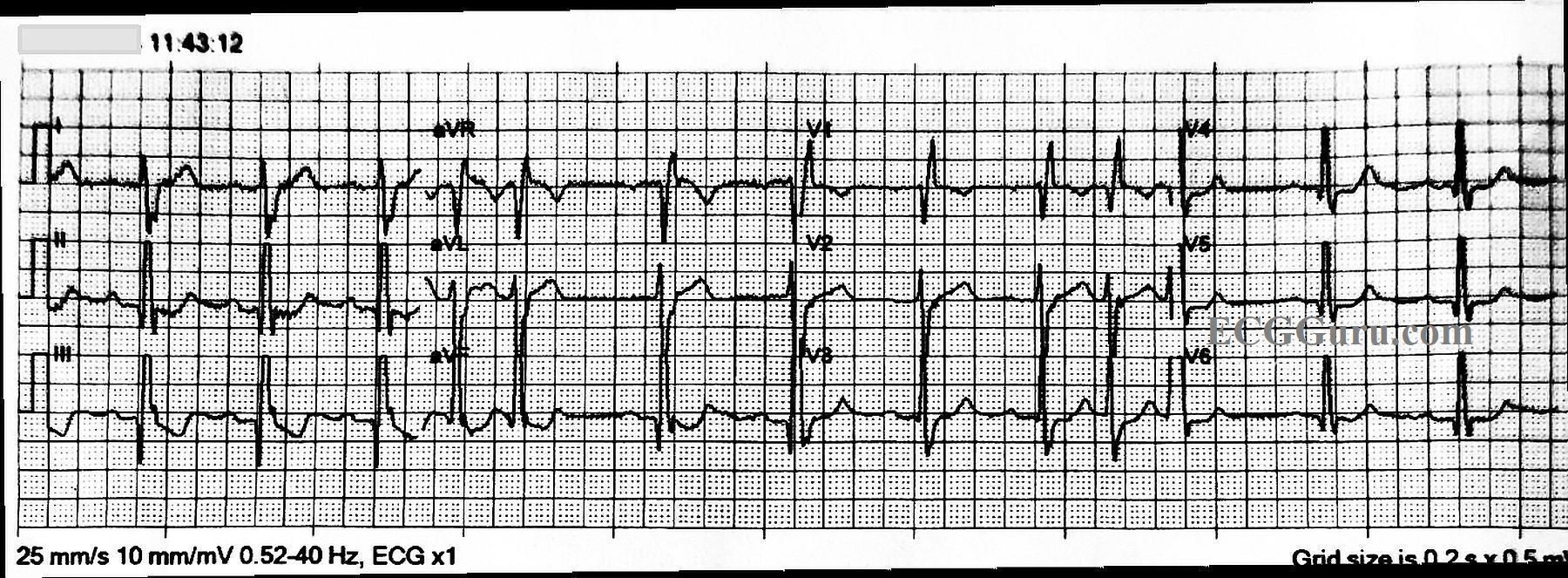
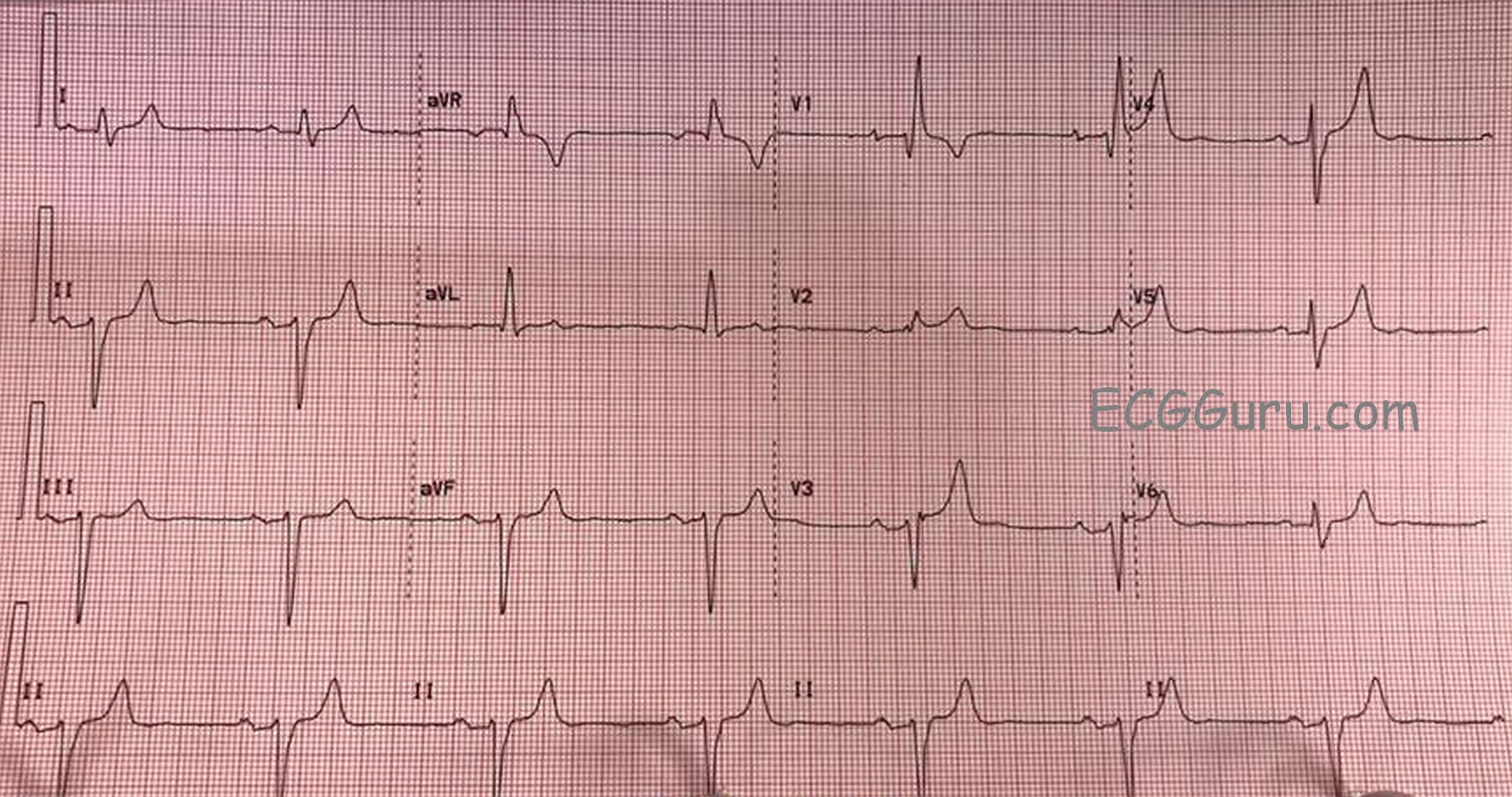
This is quite an interesting ECG, and the ECG Guru would love to hear what you think about it.  What we do know is that it is a wide-complex bradycardia in a patient for whom we have no clinical data, except that she is a 51 year old female.  The rhythm is probably junctional, as no P waves are seen and the rhythm is regular.  The rate of 63 per minute would be consistent with that. Interestingly, no disassociated sinus P waves are seen.  All slow wide-complex rhythms should be evaluated for idioventricular origin, or AIVR.  The QRS in V1 shows an atypical right bundle branch block pattern.  We usually look for rSR', or "bunny ears",  but  this ECG shows an upright R wave with a smaller, slurred r wave before it.  What makes this look like RBBB is the prominent wide little S wave in V6 and in Lead I.  We question the R wave progression, too.  Do you think it is possible that the electrodes for V2 and V3 are switched?  The axis is leftward, causing Lead II to be nearly biphasic - it represents a synthesis of what is seen in Leads I and III.  This is enough left axis shift to diagnose a left anterior fascicular block (with RBBB = bifascicular block). 

This is a great ECG, and we can't wait to hear from all you ECG Gurus out there. Maybe we will need to adjust our diagnosis after we hear from you.

Right Bundle Branch Block With Left Anterior Fascicular Block

Fri, 02/08/2013 - 00:00 -- Dawn

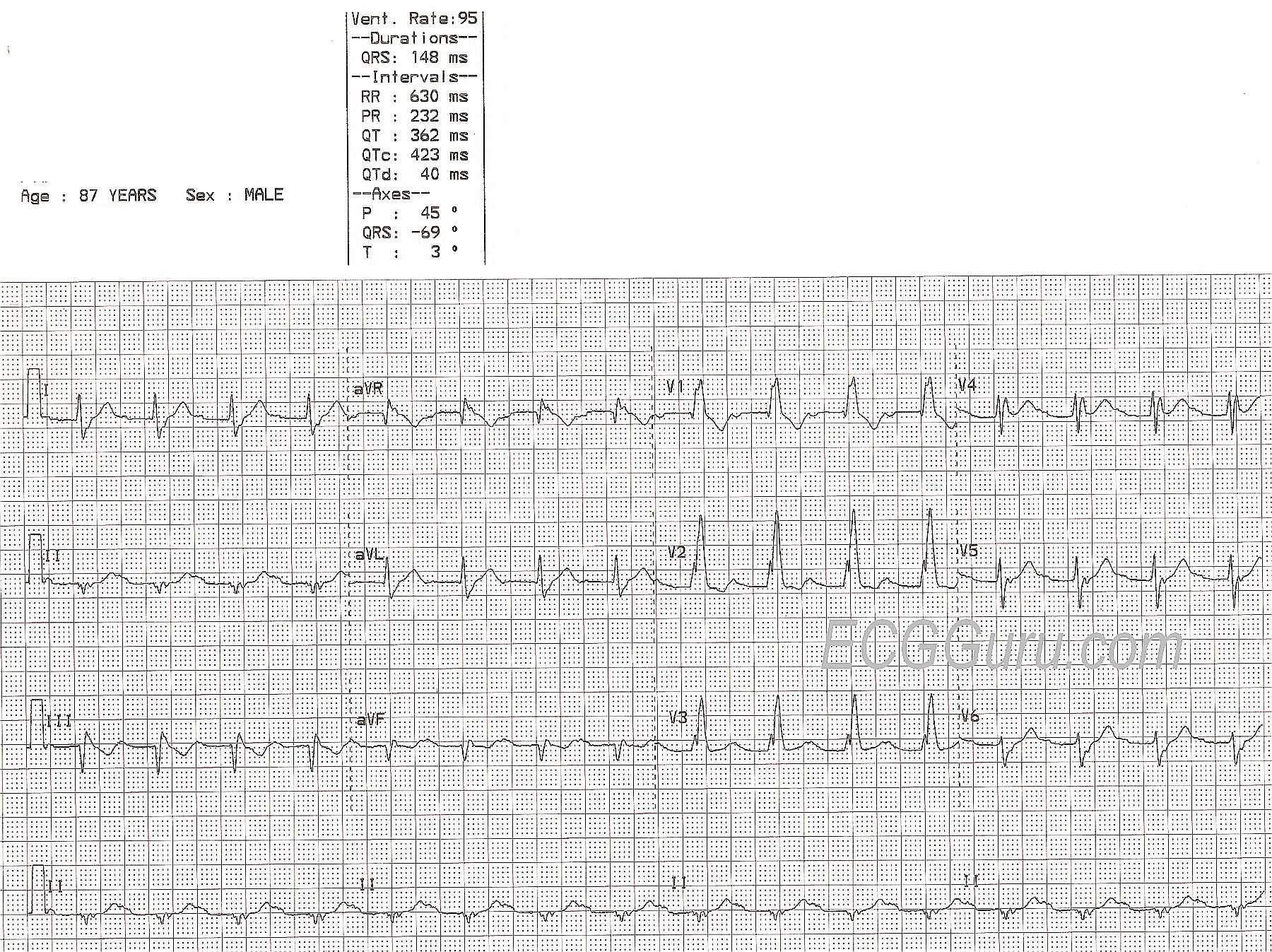
This is a nice, clear right bundle branch block pattern: wide QRS, supraventricular rhythm (NSR), and rSR' pattern in V1. Wide little s waves in Leads I and V6 are also diagnostic. The left axis deviation indicates a left anterior fascicular block, since there is no other apparent reason for the left axis deviation, such as pathological Q waves or LVH. Left anterior fascicular block is a diagnosis of exclusion, also considering that RBBB and LAFB are often seen together (bifascicular block), since the two fascicles have the same blood supply.

You may use this image free of charge to enhance your presentations or student handouts. Click on image, or, for best image quality, right click and SAVE image. For permission and charges for use in publications or for marketing uses, please contact the owner at ECGGuru@Comcast.net.

This work is licensed under a Creative Commons Attribution-NonCommercial 3.0 Unported License.

Third-degree AV Block and Junctional Escape Rhythm With Right Bundle Branch Block and Prolonged QTc Interval

Sat, 01/26/2013 - 14:48 -- Dawn

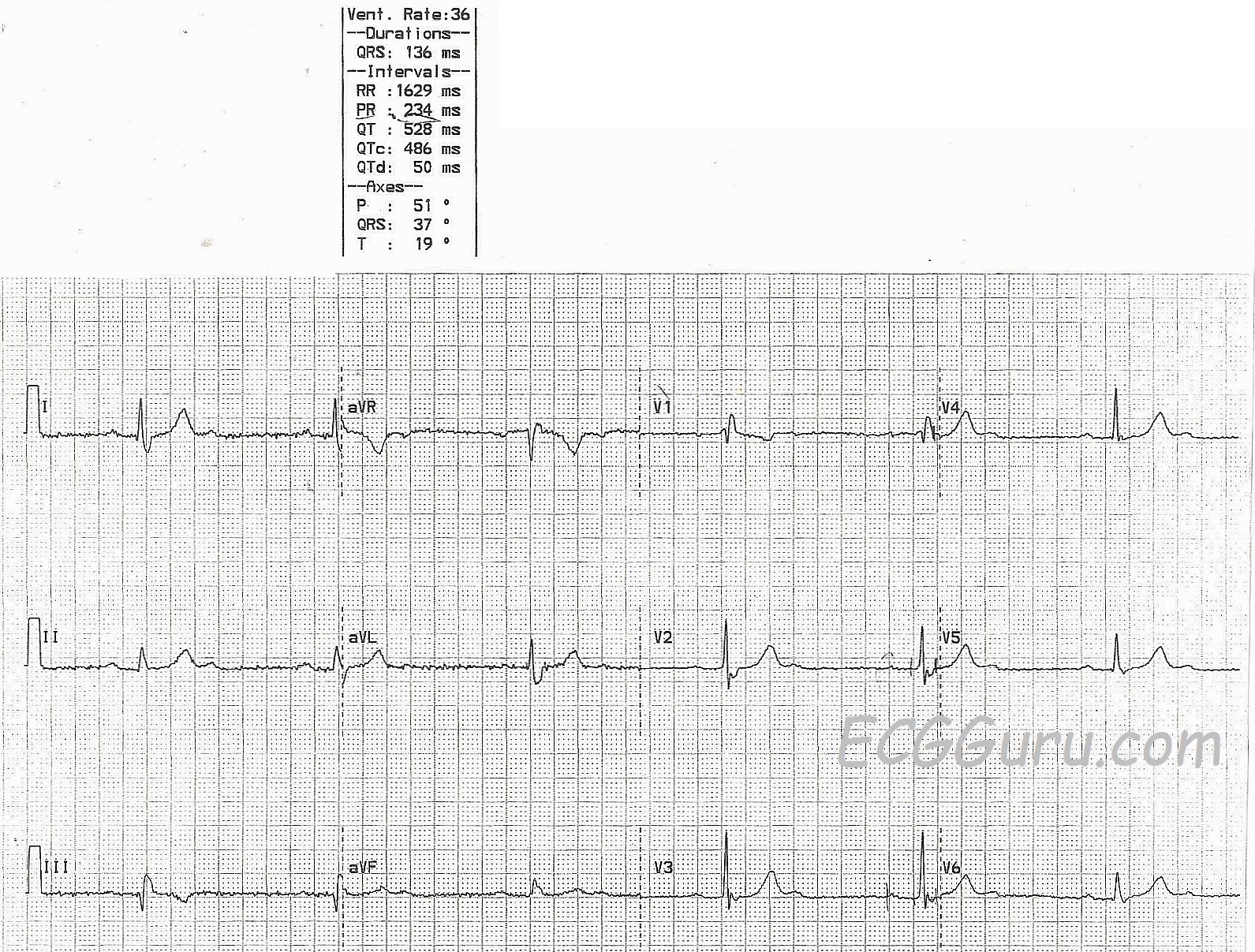
This ECG is from a 70 year old woman for which we have, unfortunately, no clinical information.  It shows a sinus rhythm with a rate of about 72 bpm (NSR) with AV dissociation caused by third-degree heart block.  The escape rhythm is junctional at a rate of 38 bpm.  There appears to be a right bundle branch block, based on the QRS duration of 132 ms, and a wide S wave in Leads I and V6.  The precordial leads do not show the usual RBBB pattern of rSR' in V1 and V2, and the r wave progression is poor (non-existent).  This is felt to be due to poor lead placement (a good teaching point).  Of interest, the ECG machine has reported a "severe right axis deviation" based on the tall upright R wave in aVR and the deep S in avF.  In RBBB, the first part of the QRS represents left ventricular depolarization, and the terminal wave represents the delayed right ventricle.  In effect, the two ventricles have their own electrical axes, which we can see because the ventricles are not depolarizing simultaneously.  The axis of the LV appears to be normal in this tracing.

In addition to the above, this patient has a very prolonged QT interval.  The QT is longer in bradycardic rhythms, but when corrected to a standard of 60 bpm (QTc), this patient's QT interval is still prolonged at QTc: 552 ms.  Without clinical data, we cannot speculate  as to why this patient's QTc is prolonged, but it can be a very dangerous situation.  Follow the links for more information on QT prolongation and Torsades de Pointes and Long QT Syndrome.

As always, we welcome comments from our members adding insight to this interesting ECG, and also questions you would like to ask our Guru members.

Right Bundle Branch Block and Previous Anterior Wall M.I.

Sat, 12/22/2012 - 14:41 -- Dawn

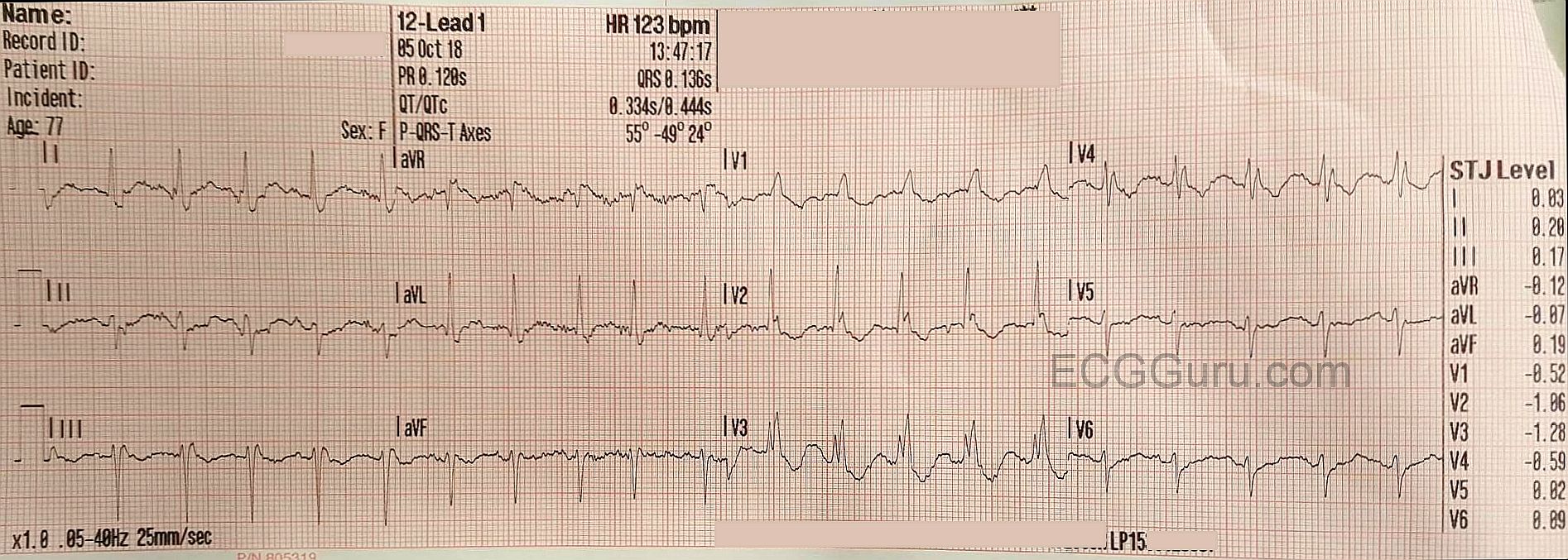
This example of previous anterior wall M.I. with right bundle branch block is from a 90-year-old man.  He survived an anterior-septal M.I. caused by an occlusion of the left anterior descending branch of the LCA. The septum was involved in the damaged area, and the patient was left with a right bundle branch block.  The pathological Q waves in Leads V1 through V3 show the location of permanent damage, or necrosis.

In this case, the usual rSR' pattern of right bundle branch block is replaced by qR, indicating loss of the initial r wave due to the M.I.

Review of RBBB criteria:  wide QRS, rSR' pattern in V1, and Rs with a slurred s wave in I and V6.  These criteria must be present in a SUPRAVENTRICULAR rhythm to diagnose RBBB.

Right Bundle Branch Block

Sat, 11/03/2012 - 02:06 -- Dawn

This ECG is from a healthy young man in his 20's.  He was born with a ventricular septal defect (VSD) that was surgically repaired when he was a toddler.  He now has a right bundle branch block, which could be a result of the defect, or the surgery.  This is a good ECG for the Instructors' Collection because it clearly shows all the ECG characteristics of right bundle branch block:  wide QRS in a supraventricular rhythm (in this case, NSR), rSR' pattern in V1, wide or "slurred" S waves in Leads I and V6.  There is no rhythm strip below the 12 leads in this ECG, but there is no rhythm disturbance.

jer5150's picture

Jason's Blog: ECG Challenge of the Week for Oct. 21-28.

No clinical patient data available for this 12-lead ECG.

What does this tracing show?  Choose the correct answer from the list below.

(1.)  Sinus bradycardia with atrial bigeminy; conducted APBs; prominent U-waves; RBBB
(2.)  Sinus rhythm with 3:2 and 2:1 Type II A-V block; RBBB
(3.)  Sinus rhythm with atrial bigeminy; both conducted and nonconducted APBs; RBBB

Acronyms:
APBs = atrial premature beats
RBBB = right bundle-branch block

Subscribe to RSS - RBBB