ECG Guru - Instructor Resources

A gathering place for instructors of ECG and cardiac topics.


Subscribe to me on YouTube

Third-degree AV Block

Complete Heart Block

Sat, 04/27/2013 - 23:38 -- Dawn

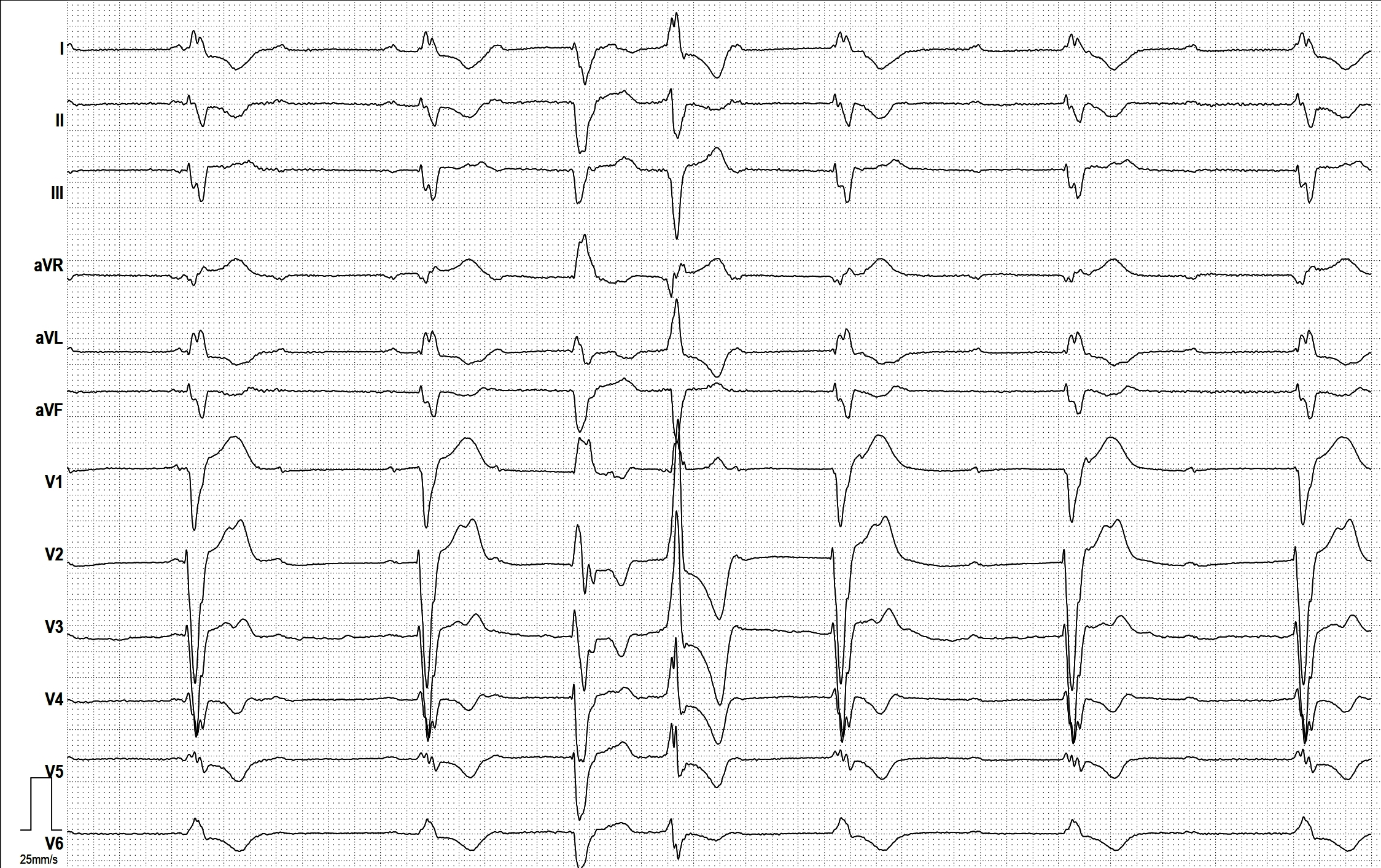
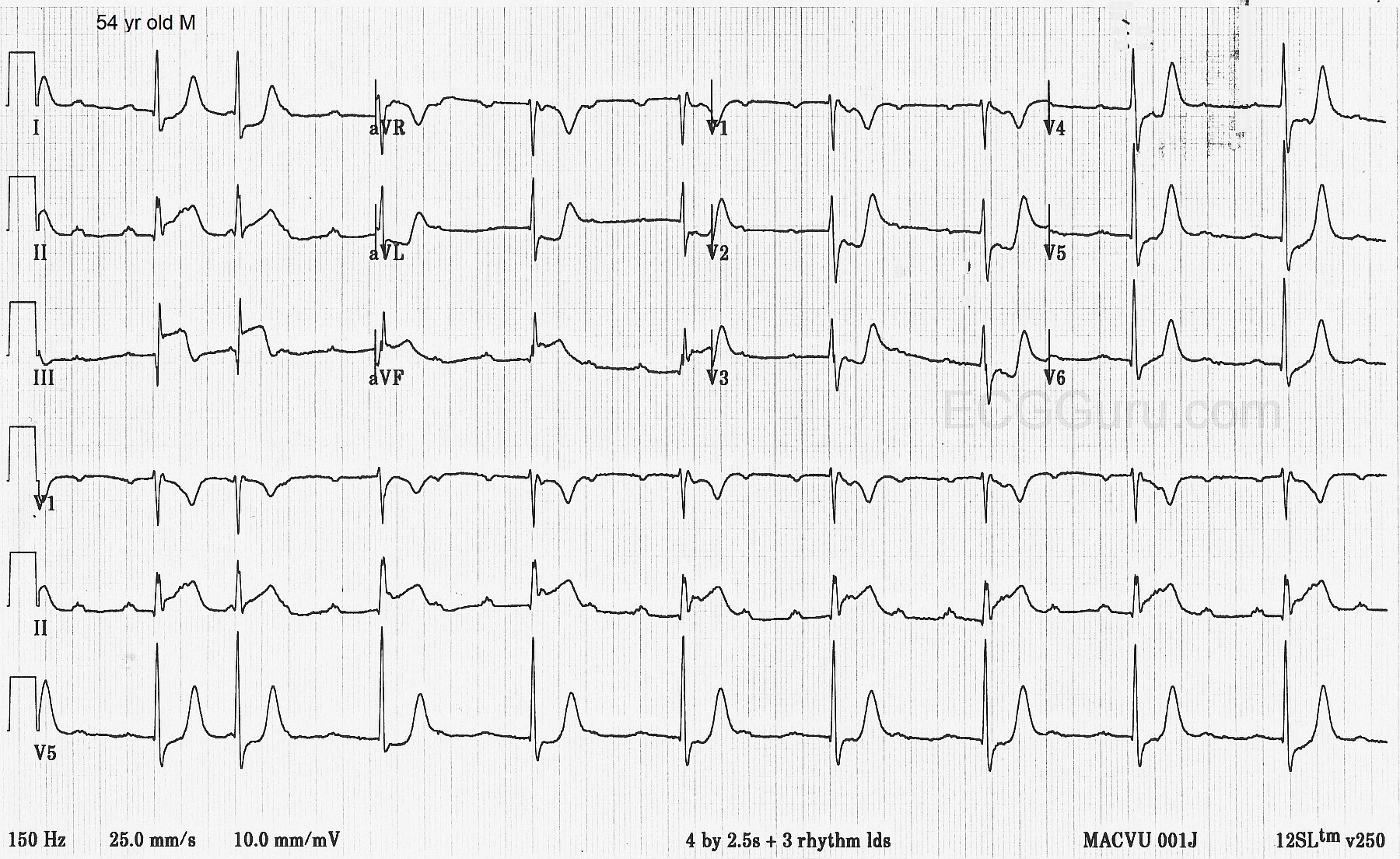
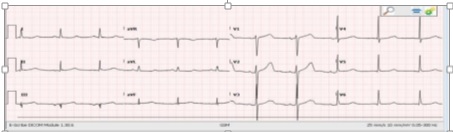
This week's ECG of the WEEK was donated to us by Sebastian Garay. These two ECGs were obtained less than 30 seconds apart from an 84 year-old man who called fire-rescue because he felt dizzy and fell.  He was not injured in the fall, and his vital signs remained stable, with an adequate BP.  These two ECGs were obtained prior to arrival in the Emergency Dept.

The first one shows a sinus rhythm at about 110/min.  There is a complete heart block (third-degree AV block), and the escape rhythm is a wide-complex rhythm at a rate of about 54/min and slowing severely toward the end.  The second ECG was taken less than 30 seconds after the first, and shows a significantly slower escape rhythm rate at 27/min., while the sinus rate increases to 120/min.  The change is sinus rate is likely an attempt by the nervous system to compensate for the lower cardiac output as the ventricular rate slows. The escape rhythm is not only slower, but there are some changes in the QRS morphology from the first ECG.

For your basic students, this ECG serves to demonstrate the AV dissociation seen in complete heart block.  It is easy to "march out" the P waves, and see that some of them are "hiding" in the QRS comlexes.  It also shows how quickly a rhythm can change rates.

For your more advanced students, you will want to have a discussion about escape rhythms.  This one initially has a fairly fast rate, suggesting junctional origin. The QRS morphology is of the right bundle branch type, with left anterior fascicular block.  However, ventricular rhythms originating from the posterior fascicle region can have the "RBBB / LAFB" morphology.  If this escape rhythm is fascicular (ventricular) in origin, it is an accelerated idioventricular rhythm.  The second escape rhythm appears very similar to the first, with the very noticeable exceptions of QRS morphology, especially in V1 and V2, and the rate.

This patient was given Atropine in the ED, with no change to the rhythm.  We do not know what transpired after that, but suspect a pacemaker was in his future. 

We look forward to comments from our members about these two very interesting ECGs.


Third-degree AV Block and Junctional Escape Rhythm With Right Bundle Branch Block and Prolonged QTc Interval

Sat, 01/26/2013 - 14:48 -- Dawn

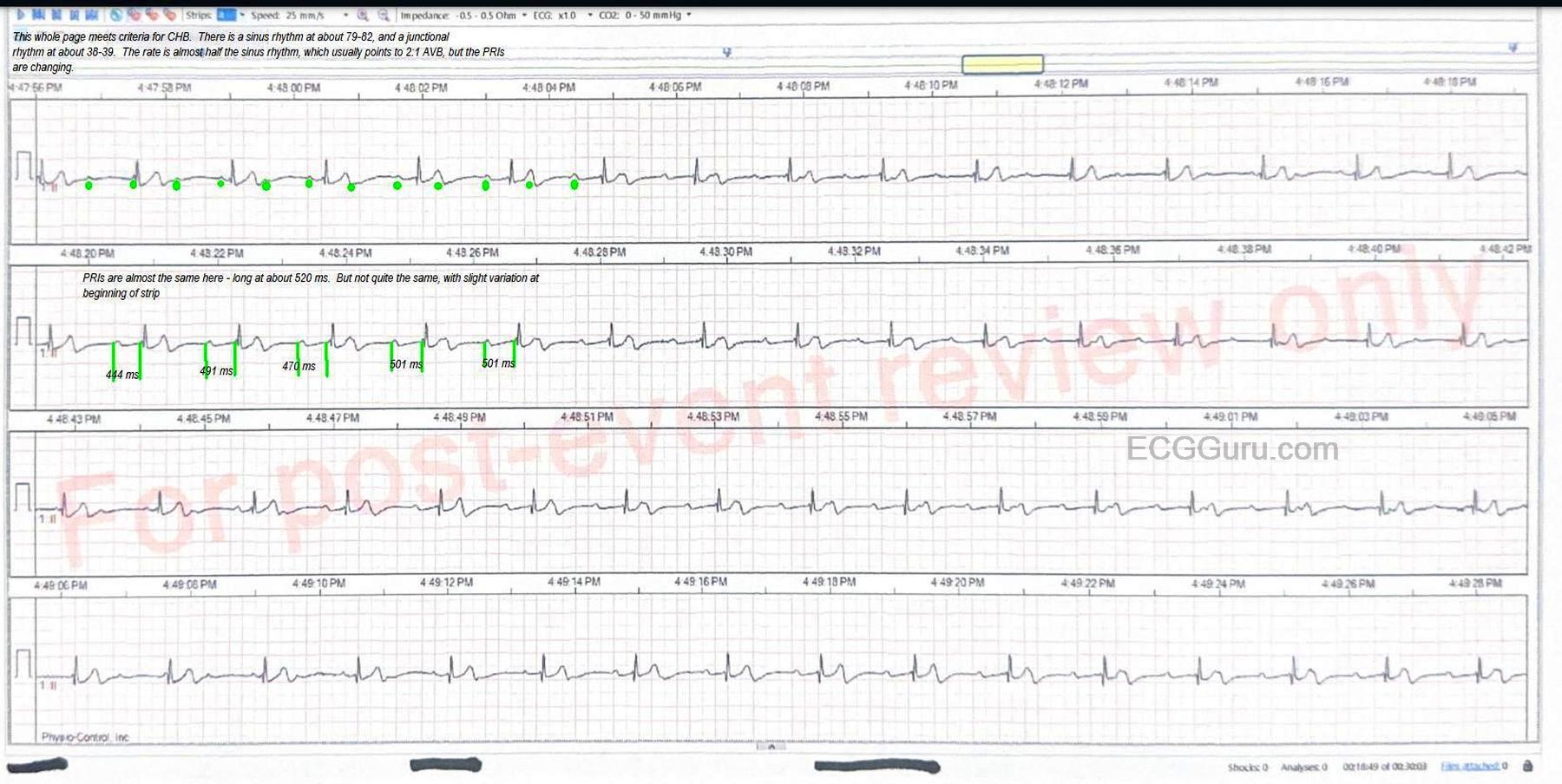
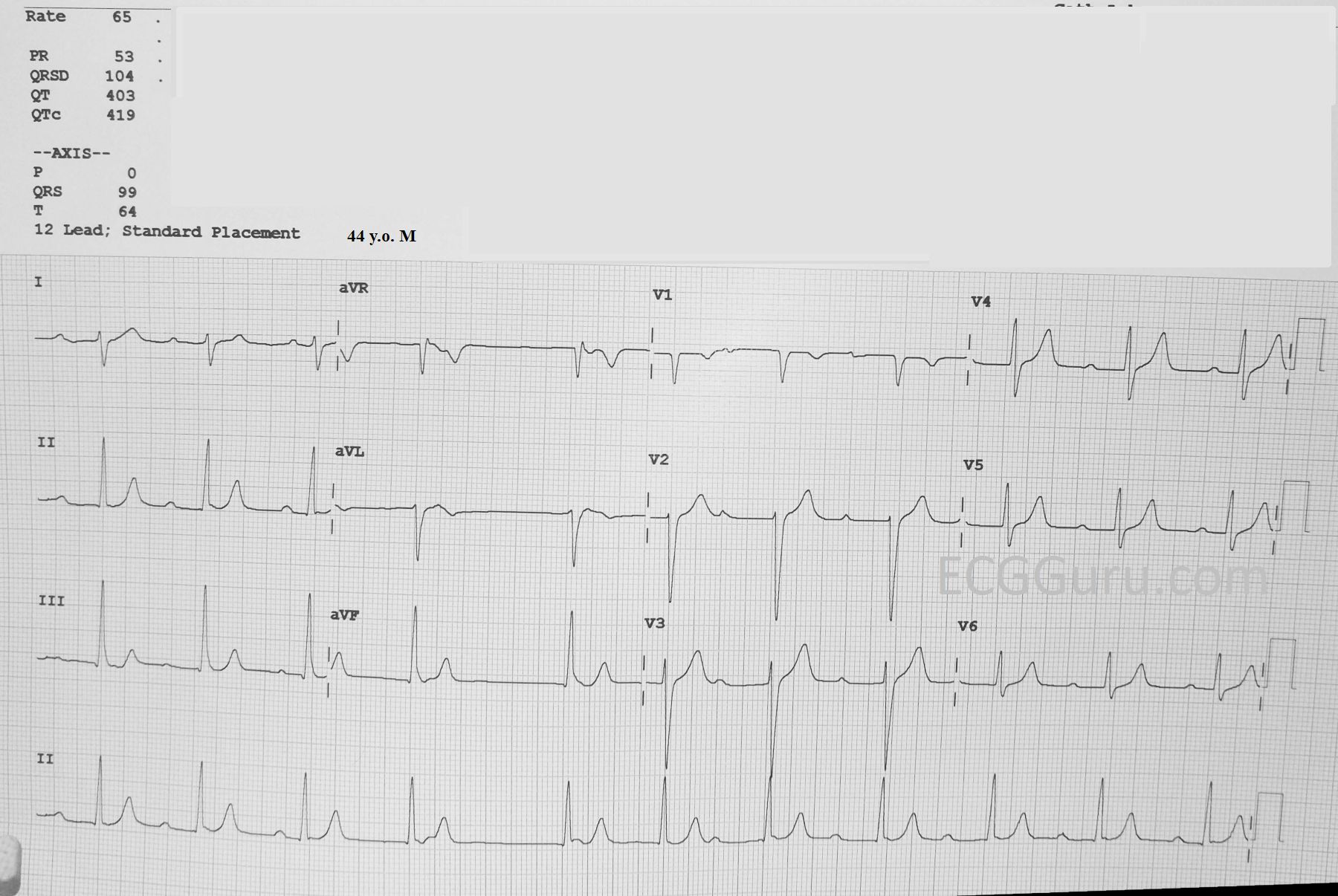
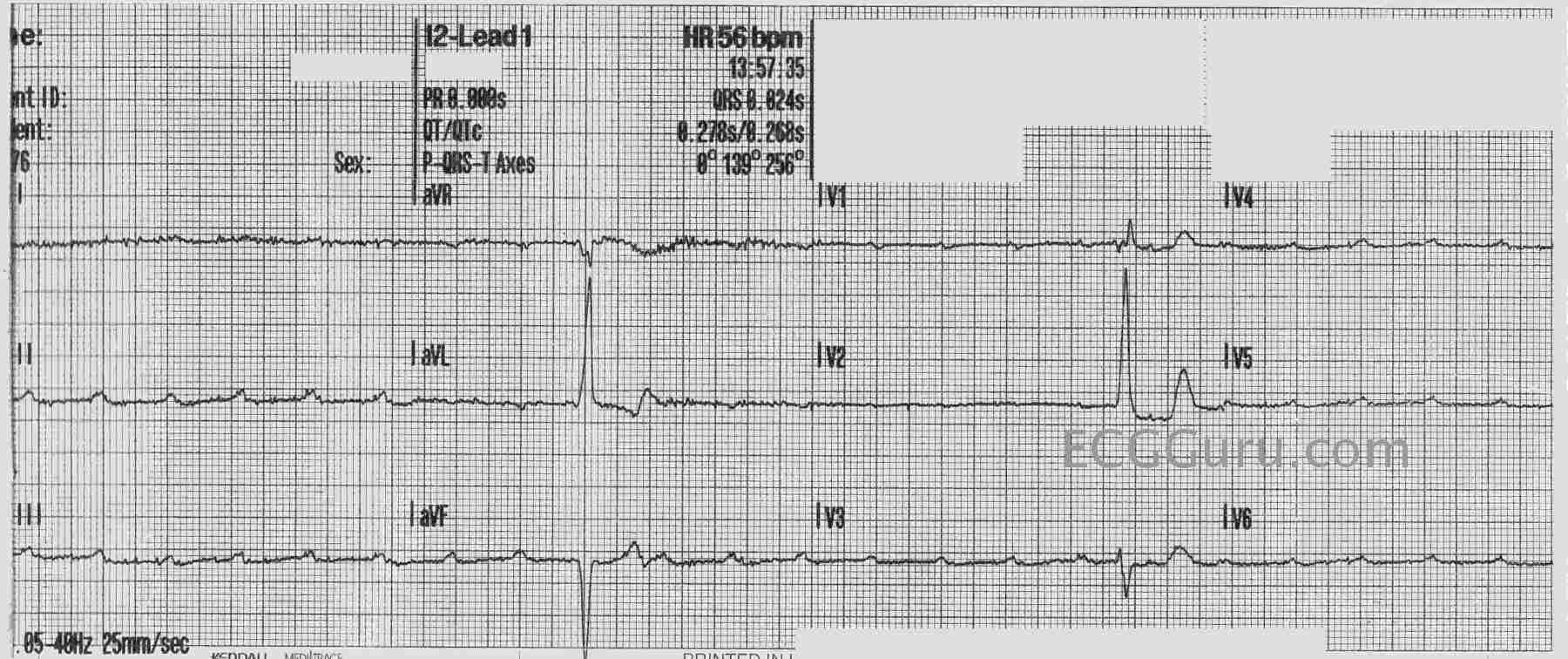
This ECG is from a 70 year old woman for which we have, unfortunately, no clinical information.  It shows a sinus rhythm with a rate of about 72 bpm (NSR) with AV dissociation caused by third-degree heart block.  The escape rhythm is junctional at a rate of 38 bpm.  There appears to be a right bundle branch block, based on the QRS duration of 132 ms, and a wide S wave in Leads I and V6.  The precordial leads do not show the usual RBBB pattern of rSR' in V1 and V2, and the r wave progression is poor (non-existent).  This is felt to be due to poor lead placement (a good teaching point).  Of interest, the ECG machine has reported a "severe right axis deviation" based on the tall upright R wave in aVR and the deep S in avF.  In RBBB, the first part of the QRS represents left ventricular depolarization, and the terminal wave represents the delayed right ventricle.  In effect, the two ventricles have their own electrical axes, which we can see because the ventricles are not depolarizing simultaneously.  The axis of the LV appears to be normal in this tracing.

In addition to the above, this patient has a very prolonged QT interval.  The QT is longer in bradycardic rhythms, but when corrected to a standard of 60 bpm (QTc), this patient's QT interval is still prolonged at QTc: 552 ms.  Without clinical data, we cannot speculate  as to why this patient's QTc is prolonged, but it can be a very dangerous situation.  Follow the links for more information on QT prolongation and Torsades de Pointes and Long QT Syndrome.

As always, we welcome comments from our members adding insight to this interesting ECG, and also questions you would like to ask our Guru members.

Inferior Wall M.I. With Third-degree AV Block

Fri, 11/16/2012 - 00:15 -- Dawn

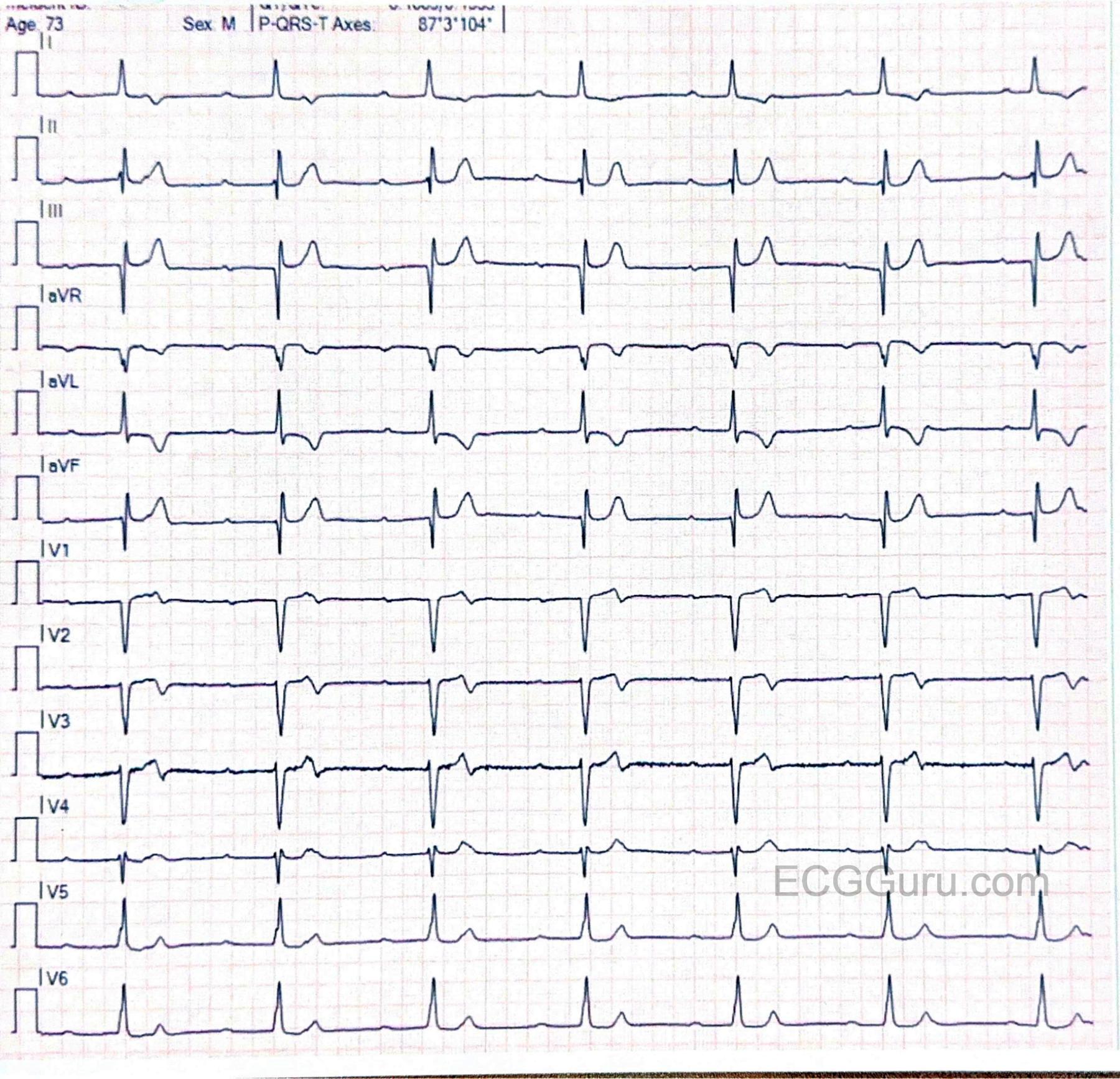
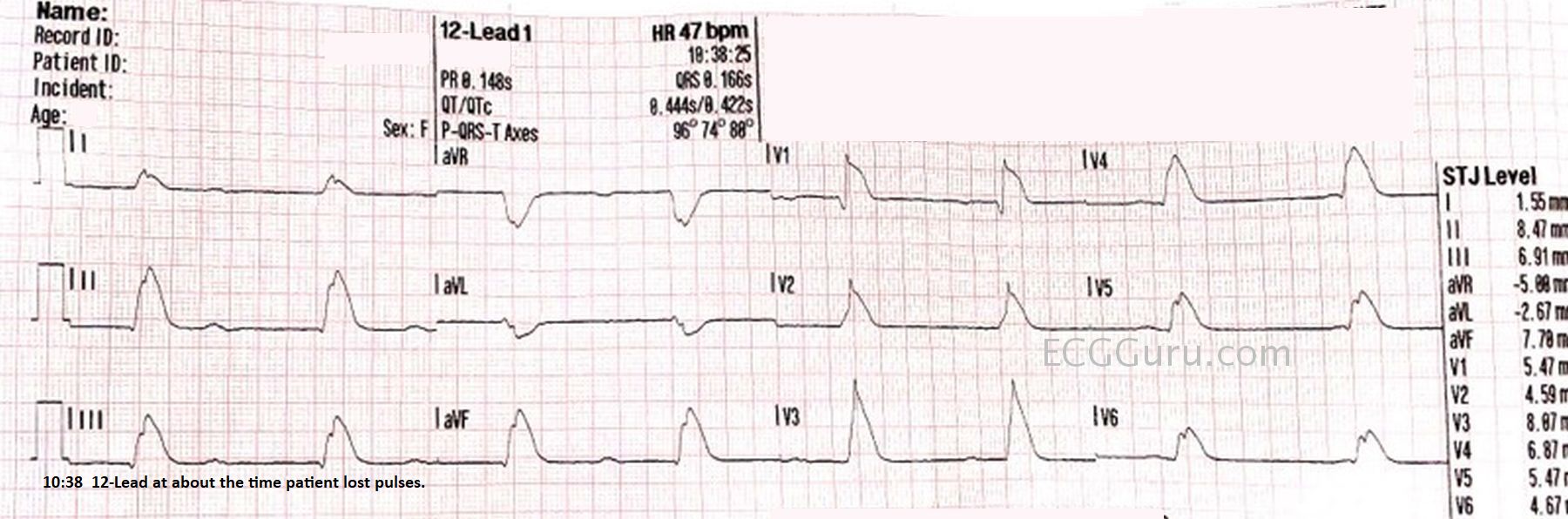
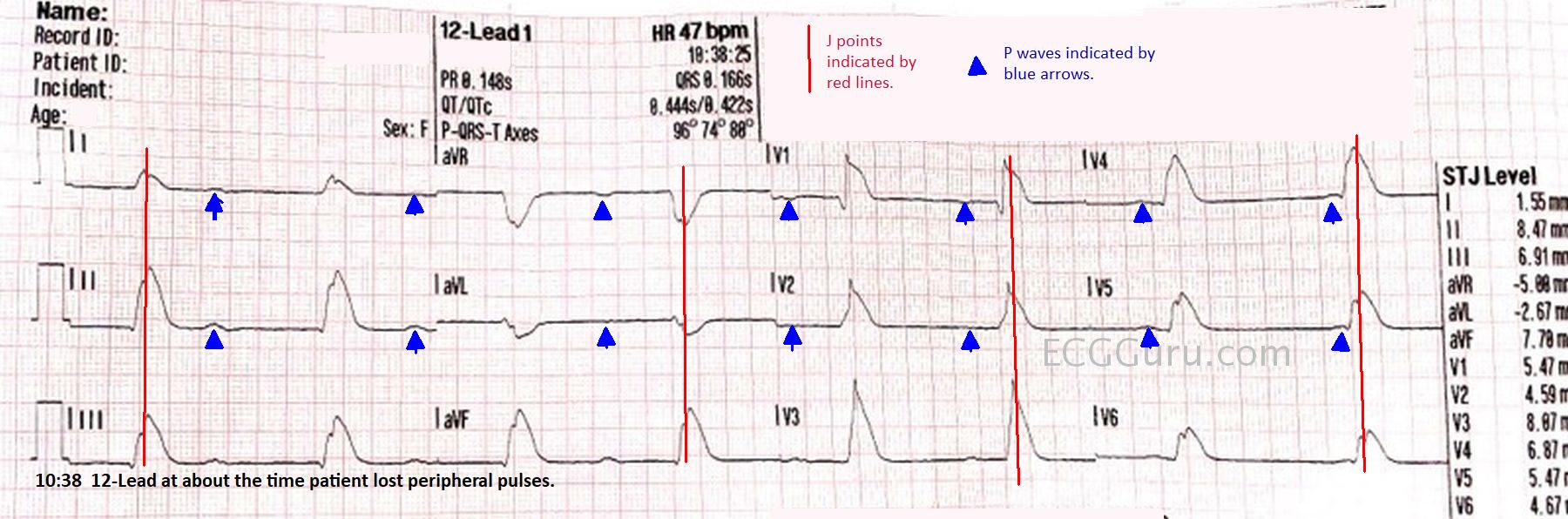
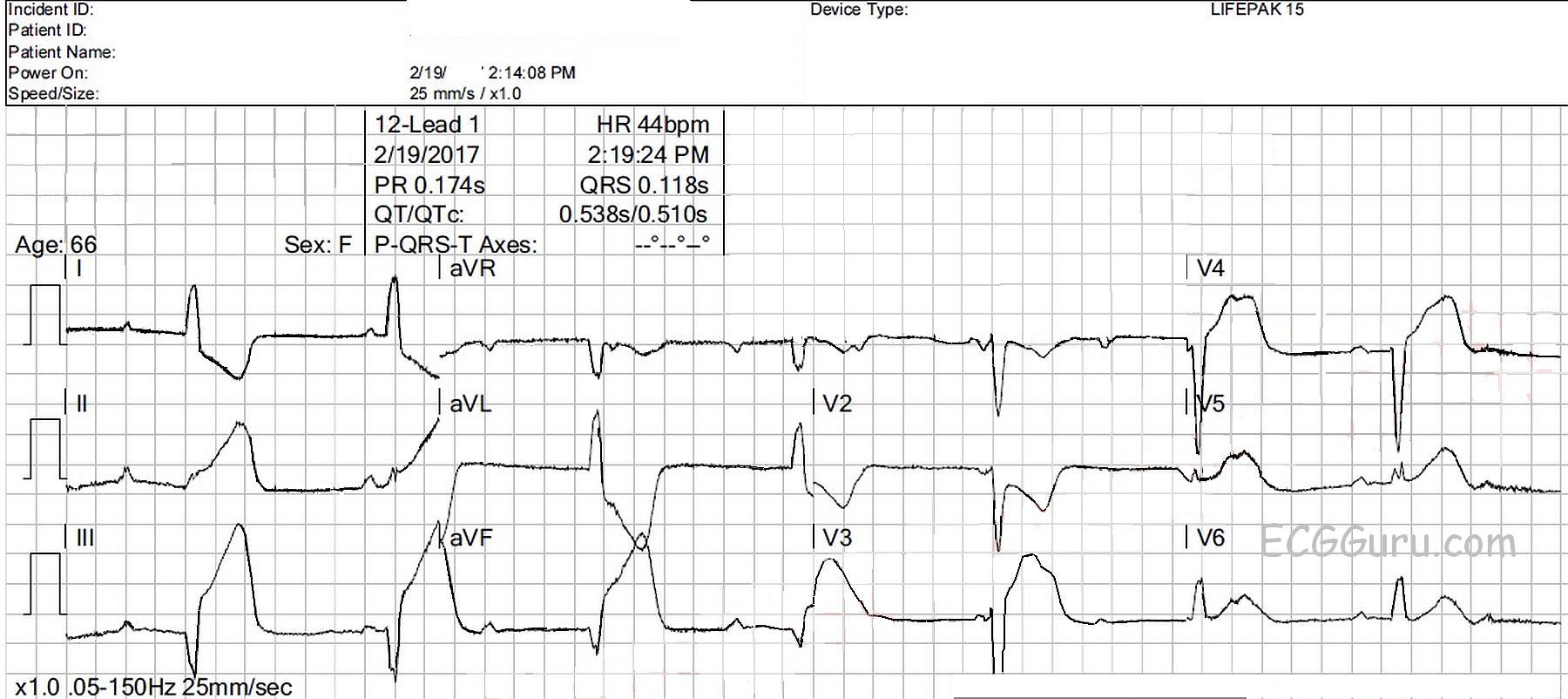
This ECG was obtained from an elderly woman who suffered a complete right coronary artery occlusion and inferior wall M.I.  In her case, the AV node was also affected, and she developed a third-degree AV block with a junctional escape rhythm.  A good ECG for ACLS classes as well as for ECG classes.  A lively discussion can be had regarding "types" of complete heart block and the nature of the escape rhythm - when to treat and when to leave the rhythm alone.  In this case the rate of the junctional escape rhythm was adequate for perfusion, and the patient's blood pressure was stable. Priority for treatment in this situation is restore blood flow through the coronary artery, if the patient is a candidate for PCI.  You might want to review Christopher Watford's contribution to the Ask the Expert page on AVB vs. AV Dissociation.

Third-degree AV Block

Wed, 08/22/2012 - 18:37 -- Dawn

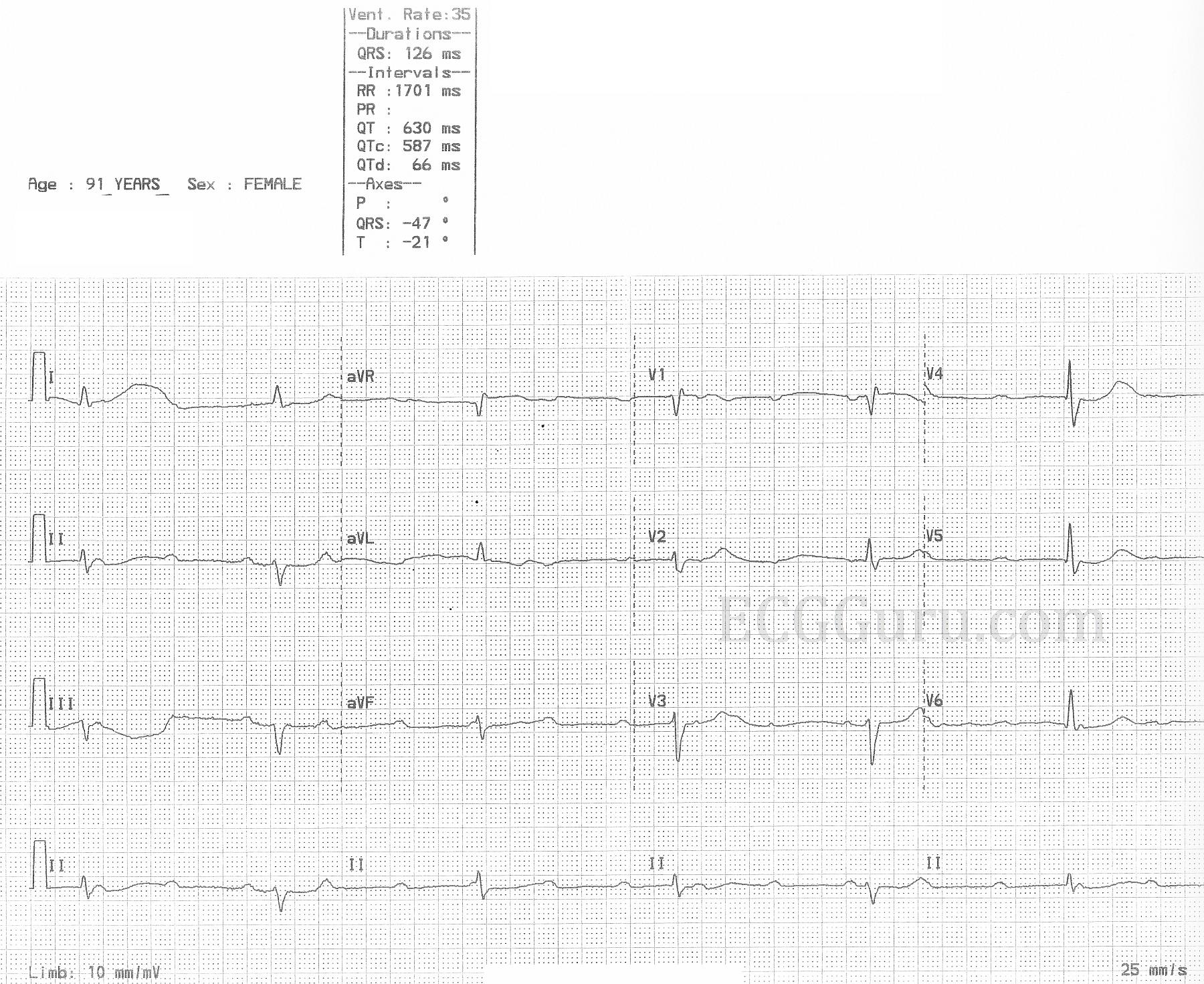
This 84-year-old man called 911 because he felt dizzy and fell.  He was not injured in the fall, but the paramedics noted a slow pulse. He denied significant medical history. The initial ECG showed sinus rhythm at about 80 bpm and AV dissociation with an apparent acellerated idioventricular rhythm at about 40 bpm.  Less than one minute later, he has developed a complete heart block with an idioventricular escape rhythm less than 30 bpm.  The escape rhythm speeds slightly toward the end of the strip.  He retained stable vital signs and adequate perfusion during transport.  It is presumed that he was scheduled for an implanted pacemaker.  It is interesting to note the machine's interpretation, and it reminds us to always interpret the ECG ourselves.   Thanks to ECG Guru member, Sebmedic, for his contribution of this ECG. 

Subscribe to RSS - Third-degree AV Block